
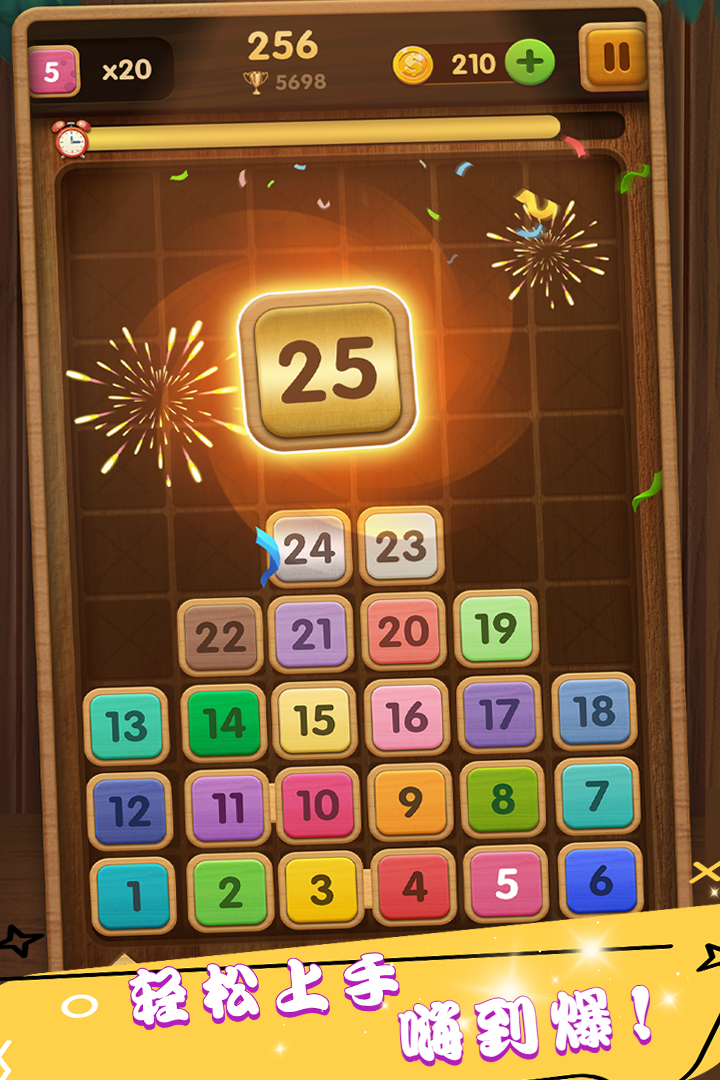
Hello fellow space-time hunters, today the editor of Qitan would like to give you a small game that is super suitable for playing in fragmented time - "Synthetic Cube"! 🧩
Although we usually find it very exciting to fight monsters and grind the game in Time Hunter, occasionally we need to change our minds and relax. This "Synthetic Cube" is the kind of casual masterpiece that you can pick up and play without getting tired of putting it down. And don't underestimate it, you need some strategy to get high scores! 🤓
Let's briefly talk about the basic gameplay: various number squares will appear on the screen. You only need to drag the squares with the same number together, and they will merge into larger numbers. For example, two 2s will become 4, two 4s will become 8, and so on. The larger the numbers, the more difficult they are to combine, until the combination is 2048 or even higher!
However, today I am not here to recite the rules, but to share a few exclusive tips to help you easily break through the high score bottleneck.
First, plan the space reasonably. 👈
The larger the block, the more space it will take up. Don't let the big block get stuck in the corner. It is recommended to place the largest number square on the edge or corner of the board, and then gradually synthesize around it. For example, put 128 in the lower left corner, and all subsequent merges will be pushed in this direction, which can avoid grid confusion.
Second, avoid blind procrastination. 🔄
Many novices rush to match two identical numbers when they see them, but sometimes they mess up the layout. For example, you were planning to combine two 32s next to 64, but accidentally merged two 8s, causing the position of 64 to be blocked. It is recommended to scan the overall situation before each operation and mentally plan the next three steps.
Third, make good use of the “area to be merged”. ✅
There is usually one or two lines left on the board as a buffer. The editor is used to placing only decimal squares (such as 2, 4, 8) in the row at the edge, placing middle numbers in the middle area, and enlarging numbers on the bottom or corners. In this way, the decimals can be added up quickly and will not take up too much space. At the same time, the large numbers also have a fixed position.
Fourth, stay calm and don't be too quick. ⏳
Synthesizing blocks is not about hand speed, but about patience. When the board is almost full, it is better to think for a few more seconds than to drag casually. Sometimes it is better to wait and let the system automatically generate the appropriate numbers than to mix them randomly just to get the grid.
Fifth, make use of the “withdraw” function (if available). ⏪
Some versions support rewinding a step, which is a valuable feature. The editor recommends using it only in critical misoperations, such as accidentally closing a 32 in the wrong position, or closing a 64 in a blind spot. Don't rely on withdrawal, after all it's more important to develop good habits.
Finally, I would like to recommend a daily routine suitable for Time Hunter players: when you are tired after finishing the dungeon, click on "Synthetic Cube" and play a few games, which can both relax and exercise your brain. The editor himself often plays a few games while waiting to form a team, and unknowingly he has created 2048! 🎉
Do you have any unique experiences? Or what is the highest number ever produced? Welcome to leave a message and share in the comment area. The editor of Qitan will select interesting replies and send them to the forum as small rewards~😊
I wish you all a happy game, and life is like a cube, the more you put it together, the bigger it gets! 🚀