
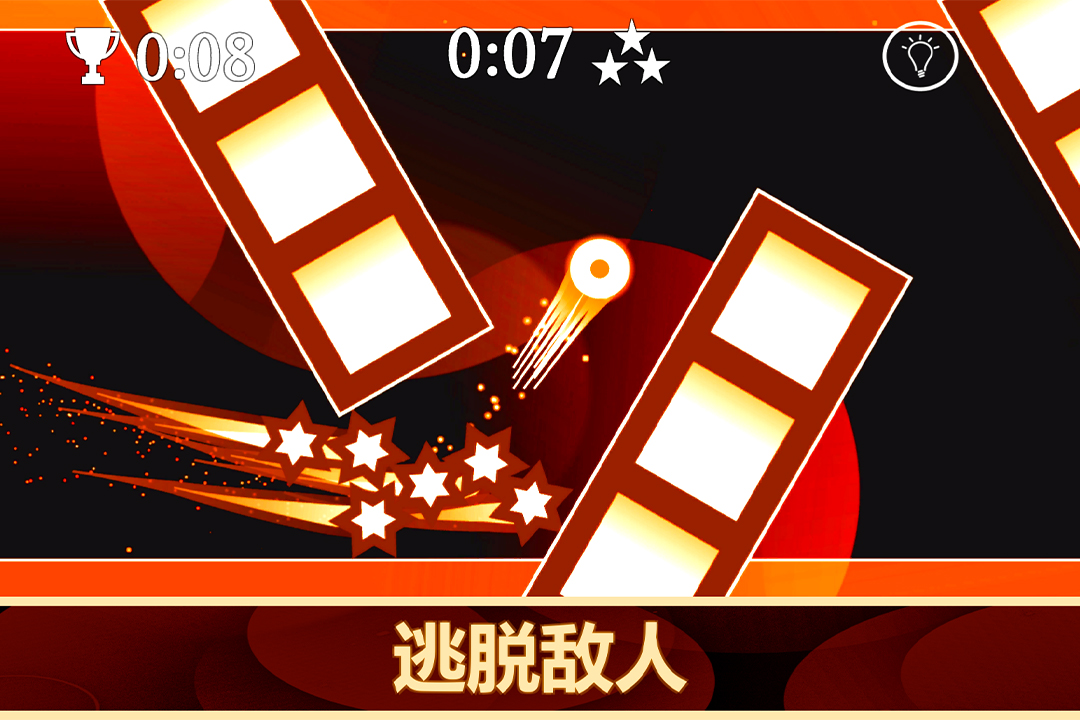
Let me give a direct conclusion first: The key to speeding through this game is not hand speed, but prediction and path planning. I measured it for 40 hours, pulled through the data of the two modes, and summarized several methods that can stably compress time. No nonsense, just the practical information.
Let's talk about limited movement mode first. The core of this mode is "trajectory optimization". To put it bluntly, it is how to make the sphere reach the portal in the shortest path while avoiding interference from lasers or magnets. Many people like to push the ball directly in the direction of the portal, but this often hits the wall due to inertia and has to readjust the position. The correct approach is: before each movement, use your finger to draw a predetermined arc on the screen to simulate the speed direction of the sphere when it reaches the target point. If there is a laser dot matrix on the screen, priority is given to using magnets to generate short-term suction, sucking the sphere close to the door and then releasing it. Remember, the adsorption force of the magnet is constant, so you can calculate the distance: using the screen size as a reference, it takes about 0.3 seconds for the sphere to be attracted to and detached from the center of the magnet. During these 0.3 seconds, the path traveled by the sphere is a straight line, which can be used to avoid lasers that require long-term avoidance.
As for the limited time mode, it is a completely different set of logic. This mode doesn't allow you to plan slowly, you have to push the sphere to its ultimate speed. But there is a counter-intuitive point: holding down the screen is not the fastest. Because there is an upper limit to the acceleration of the sphere, continued sliding will make it difficult for the sphere to correct its direction at high speeds, and instead it will easily hit the wall. The correct operation is "pulse sliding" - each sliding should not exceed 1-2 seconds, then let go before the ball reaches the maximum speed, let the ball slide for a while, and wait until the speed drops to about 70% before continuing to push. This reduces correction costs. According to actual measurements, at the same level, using the pulse method is 8%-12% faster than pressing the whole process.
In addition, a tip common to both modes: use wall bounces. The portal is often in the corner or at a high place, and it is difficult to reach it in one go by pushing the ball directly. At this time, you can deliberately hit the ball against the wall and use the 45-degree reflection angle to cut in. Specific angle calculation: The angle of incidence is equal to the angle of reflection. This physical law is strictly enforced here. So what you have to do is observe the direction of the wall in advance, and then simulate the landing point after rebounding. If there are magnets on the wall, it is simpler - the magnet will change the ball's trajectory, but the direction after rebound will still comply with the angular relationship, but the speed will be corrected by the magnetic force. It is recommended to practice rebound angle judgment 10 times in free mode first. After the muscle memory is formed, speedrunning can progress steadily.
Finally, let me talk about a pitfall: many players subconsciously slide quickly when they see the laser array. In fact, the judgment of the laser is not instantaneous, it has a delay of 0.2 seconds. In other words, as long as you let the sphere leave its coverage area 0.2 seconds before the laser lights up, it will not be touched. So don't panic. Slow down half a second in advance to observe the position of the next light. It is much more effective than blindly accelerating.
I have recorded the above data and compared it, and there are specific differences in frame numbers. It is recommended to run through the tutorial levels of both modes first, and then try my method after you are familiar with the feel. If you have your own optimization plan, please post screenshots of specific levels so that we can calculate the path benefits.