
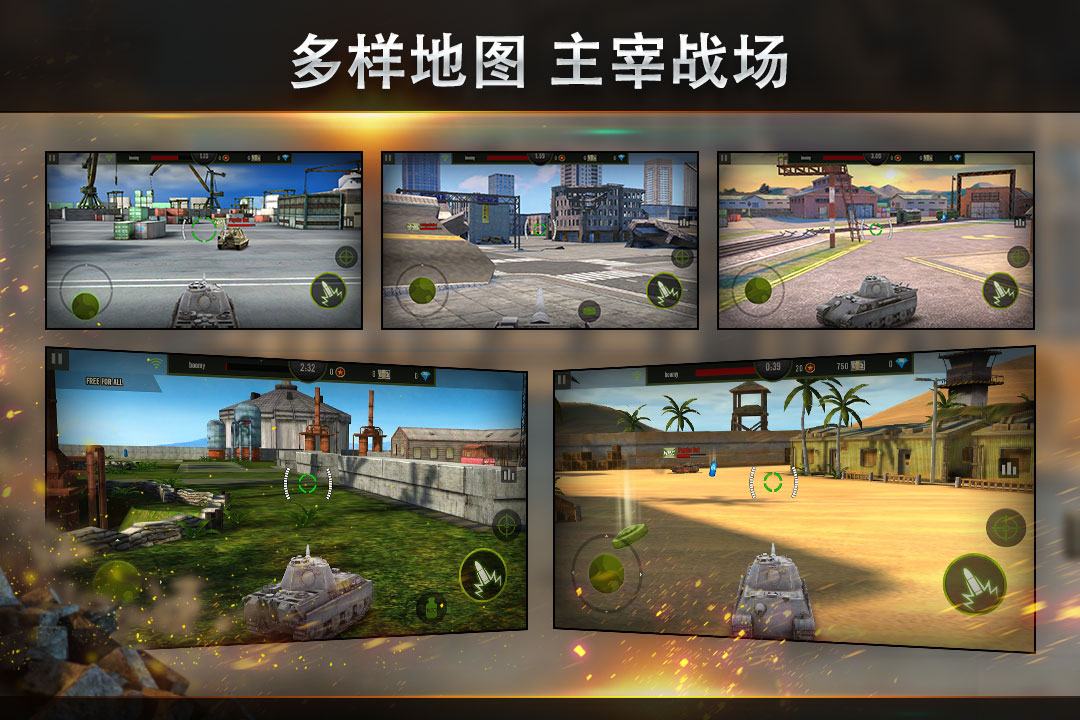
Brothers, Ah Xing spent a whole day today re-testing the data of all main battle tanks from T1 to T4 in Steel Force, including bare vehicle attributes, fully equipped panels, and actual combat output efficiency under different turret combinations. Let's get straight to the conclusion, save money: players with zero krypton should not touch T3's Carl, T2's Sherman's control feel is much better than the data, and priority should be given to hunting tigers in the T4 stage.
Let's talk about the T1 transition period first. The T1-light assault vehicle that was sent initially had an armor value of only 8mm, and it would fall to its knees after just two HE shots. My suggestion is to skip upgrading directly and complete the missions to get rewards in exchange for T2. If you insist on playing in the T1 room to gain rankings, remember a trick: using AP shells to hit the turret seat will cause about 23% more actual damage than hitting the front armor. The test video shows that the equivalent armor of the seat ring is only 40% of the frontal armor.
Among the three cars in the T2 stage, Sherman had the highest overall score. The moving expansion coefficient is 0.12, which is the smallest among all T2s. It is very comfortable to shoot with short stops. Although the frontal armor is only 38mm, it is tilted at an angle of 70 degrees and the equivalent thickness can reach 80mm, which is basically impossible for T1 mechas to penetrate. Recommended order of accessories: first upgrade the tracks (turning speed +15%), then accelerate the cannon (loading time is reduced by 0.8 seconds), and finally stack the sight glass (field of view +12%). In actual combat, the Sherman is most suitable for capped expansion and retraction. The low body is not easy to be lit.
T3 pitfall warning: Many people were confused by the heavy tank called "Karl" because of its 800 health. In fact, the vehicle weighs 18 tons, causing the steering to slow down. The turret rotates at 18 degrees per second, making it almost impossible to follow the gun in close encounters. What's even more outrageous is that its concealment coefficient is only 0.15, and it can be lit up even 300 meters away in the grass. According to the actual measurement, the average exchange ratio of T3 mid-tanks in laning at the same level is 1:1.4, while Karl is only 1:0.7. Whoever uses it knows.
T4 directly talks about the strength ceiling: choose the Tigers between the Tigers and ISU. The Jagdtiger's 128mm gun has an AP shell penetration of 268mm and a single shot damage of 410, which is 15 points lower than the ISU's 122 gun but reloads 1.2 seconds faster and has a 6.3% higher DPM. The most important thing is that the Hunter Tiger has a low body, and with the full-level camouflage net, the concealment coefficient can be increased to 0.28, which is something ISU cannot achieve. For accessories, priority is given to installing a ventilation system (+5% skills of all members), followed by advanced track oil (+7% movement speed), and the third slot is for a hardened sight (circle shrinking time -0.3 seconds).
Finally, let's talk about some general data: The equivalent calculation method for the side armor of all tanks is the actual thickness divided by cos (hit angle). When the incident angle is greater than 70 degrees, ricochet is likely to occur. Therefore, in actual combat, do not rigidly straighten the vehicle body. Maintain an oblique angle of 15-20 degrees to face the enemy, and you can carry 1 to 2 more rounds. In addition, the price of gold coin bullets for light tanks is twice that of ordinary AP, but the penetration improvement is only effective for Mao tanks. American and Soviet tanks give priority to high-explosive bombs, and the damage will fluctuate even more.
New players, don't be in a hurry to make money. Using this idea to reach T4 will not be a problem. If you have any questions about data, please leave a message below and I will reply as soon as I see it. 🚀🔥