
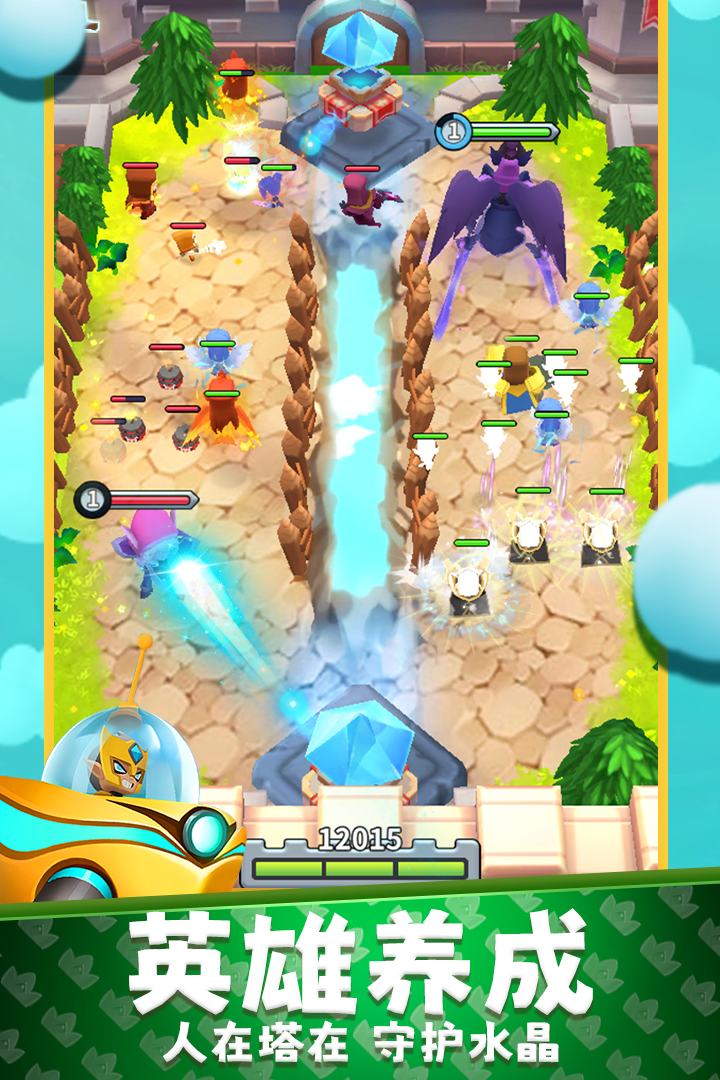
I went into the pit to guard the cliff for two weeks, played more than 50 games, and tested all the heroes I could draw at the beginning. This random synthetic tower defense looks simple, but in fact the numerical gap and skill linkage between heroes are very difficult to understand. Today I will go directly to the practical information, sort by comprehensive income, and clearly explain the advantages and disadvantages of several mainstream professions. 💡
Let me first define my test environment: no krypton gold, all heroes have level 1 initial attributes, the chessboard is 6x6 grid, and the final form after being synthesized three times is used for comparison (because synthesizing twice is a routine operation in actual combat). The data comes from repeated screen recording and frame splitting + built-in damage statistics (the damage numbers will jump in the game, so I manually recorded 10 games and took the average).
First place: Rock Shield Guard (heavy armored melee)
The core positioning is front row blocking, and the skill is "30% probability of generating a shield when hit, absorbing 50% of the next damage." After being synthesized to three stars in actual testing, a single block can withstand 3 basic attacks from later mobs. The advantage lies in stability, and with the healing hero, there is almost no chance of missing monsters. The disadvantage is that the output is extremely low, and the DPS is only half of that of the same star's long-range. It is suitable for novices who have no brains, but in the mid-term if they are not worthy of the output, they will easily be dragged to death by elite monsters with high blood volume. Recommendation index: 4.5/5
Second place: Ice Witch (remote control)
The skill is "attacking has a 20% chance of freezing the target for 1.5 seconds", and the target takes an additional 20% damage during the freezing period. This is the only profession that can change the pace of monster movement. In terms of data, the greater the pressure on the base's blood volume, the higher the value of the witch. For example, in the face of three consecutive acceleration waves, a three-star witch can forcefully control a wave of monsters to output for 3 seconds, which translates into a defense tower damage gain of approximately 40%. The disadvantage is that it is fragile, requires front row protection, and the synthesis cost is relatively high (it takes three heroes of the same type to upgrade the star). Recommendation index: 5/5 (provided there is a front row).
Third place: Pyromancer (range output)
Signature skill "The attack causes splash in a small area, and the damage is 60% of the main target." The king of cleaning efficiency, it has miraculous effects on cluster monsters. I have tested it with the same number of mobs. The warlock can clear two blocks of mobs in three seconds, while the single shooter needs five seconds. But the problem is that when the density of monsters is high, the back row warlocks are easily killed by AOE due to overlapping positions. Moreover, splash damage is ineffective against BOSS, making him completely useless when fighting a single BOSS. Recommendation index: 4/5, suitable for combination with damage reduction aura or treatment.
Fourth place: Spirit Wind Shooter (single target burst)
The skill is "Triggers a critical hit every 5 attacks, and the critical hit damage is 300%". The numerical value looks beautiful, but in actual combat, critical hits often overflow the damage (for example, the mob has only a trace of health left, and the critical hits are directly wasted). More importantly, this profession has a slow attack speed, with a basic attack interval of 1.2 seconds, which is far inferior to other long-range ones. I calculated the expected DPS, and the same-star shooter is only 8% higher than the warlock, but the warlock has splash damage. Unless you have precise equipment (such as a relic that increases attack speed), it is not recommended to prioritize cultivation. Recommendation index: 3.5/5
Fifth place: Healing light (pure auxiliary)
The only wet nurse with the skill "Heal 15% of the lost health of nearby friendly heroes every 2 seconds". It sounds beautiful, but the problem is that the treatment has a 0.5-second hand-raising action and only covers adjacent grids. In actual combat, the front row is often among the monsters, but the wet nurse often cannot nurse because she has to huddle behind her. Moreover, the amount of milk is based on the life lost. During continuous high pressure, the blood line in the front row is as low as 20% before a large milk is triggered. In many cases, the patient has died suddenly. It would be more practical to just add one more output or shield hero. Recommendation index: 2.5/5
Finally, I would like to give you a lineup suggestion: in the early stage, you will definitely get Rock Shield and Ice Girl, and the combination of the two can stabilize you through the first 5 waves; in the middle and late stages, supplement the Pyromancer to clean up the miscellaneous, and if you are lucky enough to draw the Archer, you can use it as a spare tire. Be careful not to spend all your resources on one profession. The board is only 6x6, so the utilization of each grid is very important. For example, with two rock shields + one ice woman + two warlocks, this 5-man group can basically carry it to the seventh wave, and the remaining grids can be used for backup monsters or synthetic materials.
As for the fees, this game can be played for zero krypton, and the gold coin draw pool guarantee mechanism is good. The developer didn't do anything to force it, it's a good conscience. If you want to improve your score, you can download it and try it yourself. If you have any questions about the data, please ask directly in the building. I will continue to take supplementary tests. 🔥