
Let me give the conclusion first: Although this game is based on childhood IP, the numerical design is actually quite particular. Seven Calabash Babies can't be cleared by simply stacking levels. Attribute restraint and skill recycling are the core. It took me three days to clear the first 60 levels, and by the way, I tested a low-end lineup. Here's the practical stuff.
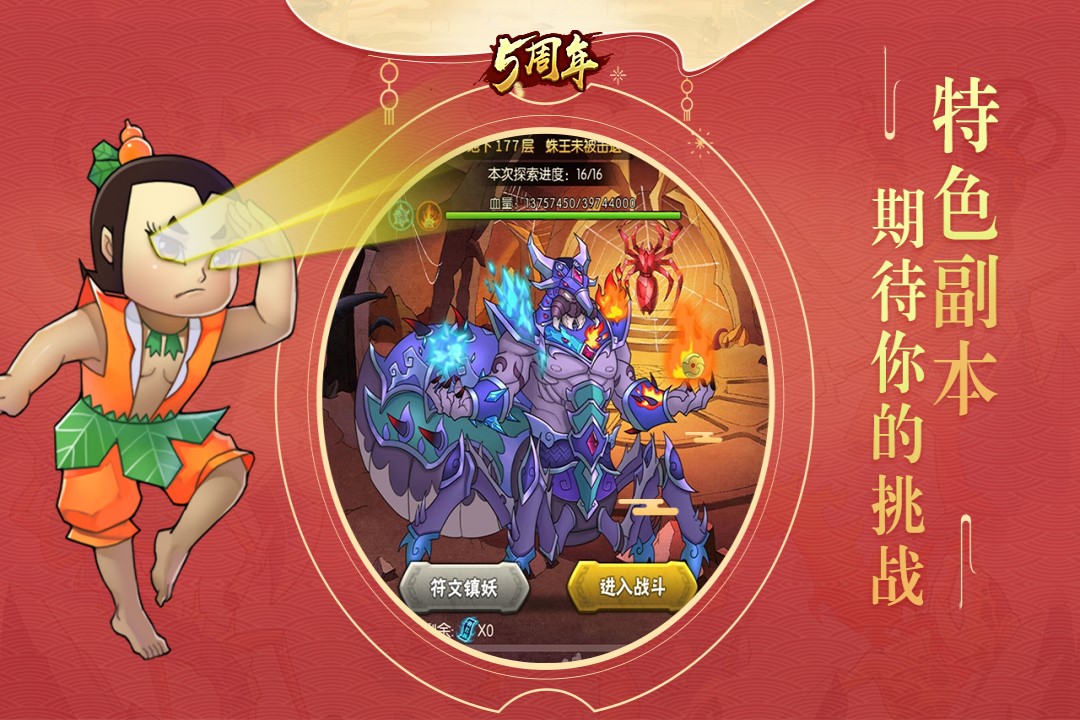
Let's talk about attribute restraint first. In the game, monsters such as snake spirits, scorpion spirits, and toad spirits are divided into three types: fire, water, and earth, corresponding to the color of the gourd doll. The red big baby (infinite strength) restrains the earth monsters, the orange second baby (clairvoyance) restrains the water monster, and the yellow third baby (indestructible) restrains the fire monster. Note that the damage increases by about 30% when restrained, and decreases by 20% when restrained. Therefore, when pushing pictures, be sure to switch the baby according to the enemy's attributes. Don't let the big baby fight water monsters, as that will cause trouble for yourself.
In terms of skill combos, the most practical combination is the big baby + the second baby + the fourth baby (fire baby). Da Wa's "Cracking Mountains and Ground" can briefly stun monsters, Er Wa's "Thousand Miles of Lightning" has a penetrating effect, and Si Wa's "Fire to Set a Prairie on Fire" is a range of continuous damage. Operation sequence: first cut the big baby to enter the field and use skills to control the field, then immediately cut the second baby to receive long-range clearing, and finally cut the fourth baby to throw the fire circle for last-minute damage. After playing a set of this set, the energy can be restored to the full cycle, and the actual test is extremely high in error tolerance against groups of monsters.
In terms of resource allocation, it is important not to cultivate people evenly. If you have no krypton or little krypton, just concentrate your resources on one main output. I personally recommend training the second baby first, for two reasons: first, long-range attacks are safe, and many bosses have melee AOE; second, the second baby's passive "divine eye" will increase the critical hit rate, and the profit will be doubled after the critical hit entry of the later equipment is released. In terms of equipment selection, attack power > critical hit rate > health. Don't believe those strategies that pile up defense. The damage of the boss in this game is numerically overwhelming, and the defensive attribute gains are extremely low.
I have stepped through several pitfalls for you. First, don't use the pangolin props given in the early stage. They are used to open hidden treasure chests. There is usually a bright spot in the corner of the second mini-map of each level. Use the pangolin to dig out a purple equipment fragment. Second, the experience books in the gold coin store are extremely cost-effective. Don't buy them. Keep the gold coins for upgrading skill levels and equipment enhancements. Each skill upgrade adds a fixed 5% damage coefficient, which is more important than level. Third, the physical consumption of a team copy is twice that of a single copy, but the rewards are only twice as much. If you are not in urgent need of materials, it is recommended to play the single copy to save energy and get one more copy.
Finally, a little trivia: when your Calabash Baby's favorability reaches 100, an exclusive plot level will be unlocked. After completing it, you will be given a limited-time attack buff that lasts for half an hour. This buff can be stacked. If you plan to hit a difficult level, you can get full favorability for the three main players in advance, and then complete three plot levels in a row. You can stack a 90% attack bonus, and use the potion to remove the boss's shield in the fourth stage in an instant. Plan your own specific operation time, don't waste it.
That's about it. The data are all measured by me. If you have any questions, you can reply to the floor and I will post the specific damage formula. 😎