
As an e-sports observer who watches KPL and LPL all year round, I usually pay more attention to the version changes of MOBA and FPS. However, a friend recommended "Cooking Kingdom" some time ago, saying that it is a "business e-sports simulator". I refused at first - after all, who would watch ordering and serving food as a competition? After playing it for two days, I found that this game is really good at numerical balance, and I can even see some of the design logic of competitive games.
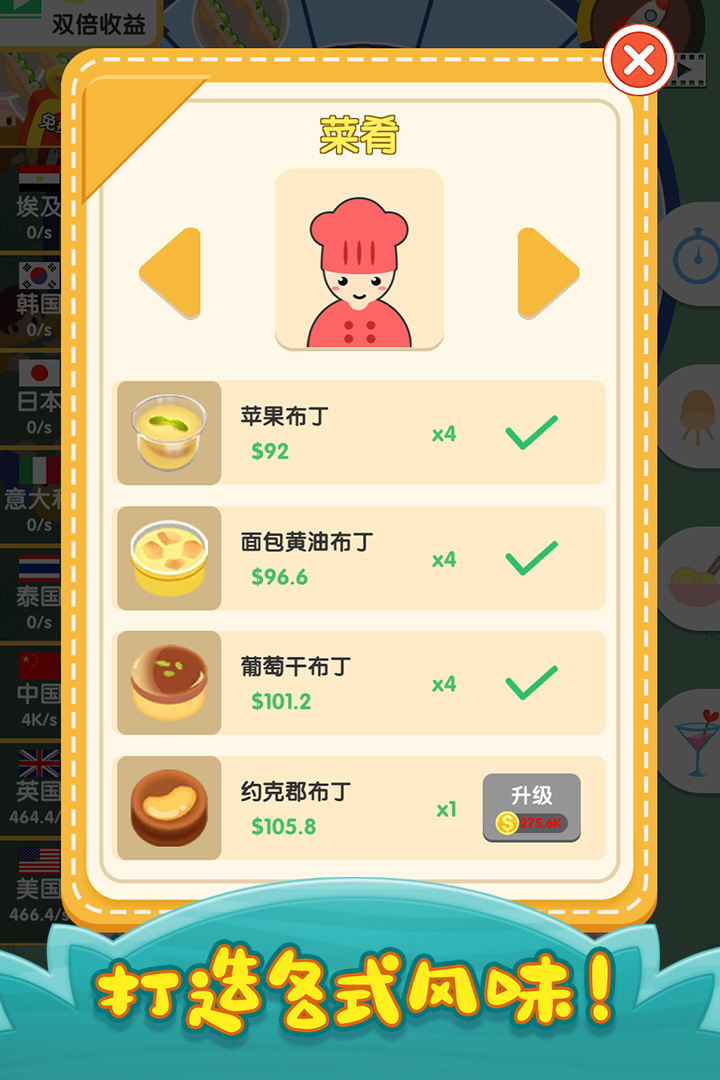
Let's talk about the core mechanics of the game first: upgrading chefs, dishes, decoration and serving speed. At first glance, this is just a linear development, but when you open the second or third restaurant, the allocation of resources becomes a typical "economic operation game." For example, should you spend all your gold coins on the chef skills of a single restaurant in the early stage, or should you diversify your investment to accelerate the progress of unlocking new restaurants? This is almost exactly the same as the idea of "get core equipment first or defensive equipment first" in MOBA. The star rating of the chef and the order in which the dishes are unlocked determine the "early rhythm" of your restaurant in each game - if a chef is too cost-effective, for example, a low star rating has a super high speed bonus, then players will all choose the "quick promotion chef stream", resulting in other gameplay (such as decoration stream, dish diversification stream) being completely marginalized. This is just like the powerful heroes in the version. If the winning rate of a certain hero exceeds 55%, the professional competition will form a rigid system and the game balance will collapse.
Let's talk about the “competitive environment” again. Although "Cooking Kingdom" does not have PVP, its "level challenges" and "limited time activities" actually simulate the tension of ranked matches. For example, if an activity requires you to obtain the highest gold points per unit of time, then you need to adjust the ratio of "serving speed vs. unit price of dishes." I found that in the current version, the revenue curve of the "Seafood Dinner" dish in the third restaurant is a bit too steep - the initial investment is small, but the later returns are much higher than other dishes, causing most players to skip the exploration of the middle restaurant and go straight to unlock it. It's like the "Holy Separator" equipment in a certain version of LOL is too powerful, everyone is producing it, and other equipment choices have become a joke. If the developers don't adjust the growth coefficient of seafood dishes as soon as possible, this game will soon become a "seafood dinner simulator" instead of a strategy planning game.
It is also worth mentioning that there is an obvious "stuck point" in the game's level limit and gold coin production speed. When a player reaches level 30, the gold coins required for upgrades increase exponentially, but the income growth of ordinary restaurants is linear. This results in players having to play the same level repeatedly in the middle and later stages, and the experience is very close to "going to jail", so many people give up. From a competitive balance perspective, this design is tantamount to setting a "pseudo threshold" that forcibly lengthens the game, rather than encouraging players to try different restaurant combinations through a reasonable difficulty curve. In contrast, version updates like KPL often lower the price of late-stage equipment or increase late-stage gold coin income, just to prevent the late game from becoming garbage time - this idea is completely applicable to management games.
Finally, I would like to add something related to the environment: There is currently a lot of controversy among players on TapTap about the "probability of triggering chef skills". Some players reported that the probability of the "French Dessert" chef's production suddenly dropped during continuous production, and suspected that there was a hidden "minimum guarantee mechanism" or pseudo-randomness. If this is true, then there is a big problem with the randomness balance of this game - similar to the controversy over the "pseudo-random critical hit rate" in the early days of King of Kings, which eventually forced the official to adjust. I hope the development team can provide a clear white paper explanation, otherwise the player community will sooner or later be turned upside down.
Generally speaking, the founder of "Cooking Kingdom" has obviously studied the operation logic of e-sports. At least in terms of the economic model, it is more sophisticated than most mass-produced simulation business games on the market. However, the numerical resistance curve, high-star chef pricing, and optimal solution solidification in event mode are all key points that need to be optimized in future versions. Finally, I would like to give you a little unprofessional suggestion: Instead of making it a hardcore stand-alone game to earn gold coins, it is better to learn from "Yunding Zhiyi", introduce a "random chef card pool" and a "public dish pool", and create a real business-type auto-chess mode - then it can truly be called a "competitive environment" 😏