
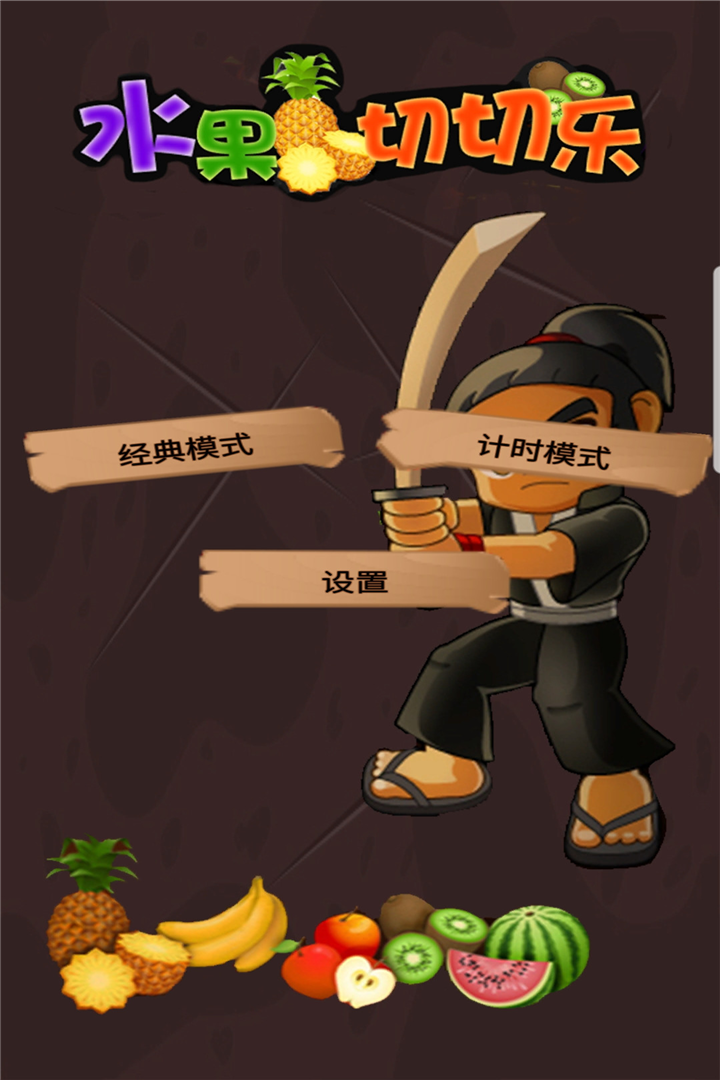
Let me start by saying: I am a heavy mobile game e-sports viewer. I usually watch a lot of KPL and LPL games. I originally didn't have much interest in this kind of stand-alone casual games. But I couldn't stand it and my friend kept making fun of it. He said that this game "gives you the pleasure of firing a big move when you cut the fruit", so I downloaded "Fruit Slicing Joy". Good guy, I couldn't stop playing it, and I even started to seriously think about whether this thing has a competitive environment and balance. Let me talk about my observations today.
Let's talk about the conclusion first: Don't underestimate this seemingly brainless fruit-slicing game. Its “competition” core is actually very hard-core, and even more clever than the balance design of some MOBAs.
From an operational point of view, it is true that this game is “easy to get started”, but the upper limit is extremely high. The trajectory, speed, and strength of your finger across the screen can all affect the decision to cut the fruit. An expert can perform three consecutive slashes in one second while dodging bombs, while a novice might just swipe randomly. This is equivalent to the CS rhythm in MOBA - the same action, details determine success or failure. If there is an online ranking system in the future, operational accuracy must be the core of differentiating ranks.
Let's talk about “balance” again. At first glance, the refresh of all fruits and bombs is purely random. It seems that there is no way to talk about balance? But if you play carefully, you will find that there are actually hidden differences in the "blood volume" and "juice splash range" of different fruits. For example, watermelons require a longer cutting path to split into two, while cherries almost break at the touch. The refresh frequency of bombs is also regular in different waves. The official has obviously designed the "pressure curve". This is like the hero adjustment in the version update-the attributes of the fruits are the hero skills, and the bombs are the version traps. If the appearance rate of a certain fruit is too high, players will adjust the cutting angle in a targeted manner, which in itself is a kind of "environmental adaptation."
In addition, the game does not have any in-app purchases (free, no advertising interference), which must be praised. Nowadays, many competitive games use "balance" as a guise, but in fact, you can become stronger by paying money. "Fruit Slicing" relies entirely on operations and reactions, and there is no room for numerical imbalance. This is much more conscientious than some mobile games that advertise fair competition.
Of course, if I want to find fault, I have to say: the lack of "Arena" mode in this game is a flaw. There are no ranks, no matches, and no leaderboards. You can only get the highest score on a single machine. If the official can add real-time online battles in the future, such as two people cutting the same wave of fruits on the same screen to compare the accuracy, it can become the next "fruit version" of table tennis or fighting games. After all, if you watch a lot of e-sports games, you will find that the real balance does not lie in the complexity of the mechanism, but in whether all players can stand on the same starting line - this point, "Fruit Slice" has achieved perfect scores.
Finally, as a party of rational analysts, I would like to give a small suggestion to players who plan to get into the trap: Don't focus entirely on the sound effects and special effects of cutting fruits. Try to predict the landing point of the next fruit and control the radius of the finger trajectory. When you get used to "cutting the most fruit with the smallest width", you will find that you have entered the state of what e-sports players call "muscle memory".
Summary: Free, no in-app purchases, in-depth operation, and perfect balance. The only regret is the lack of an online ranking system. If there is an e-sports model in the future, I will be the first to sign up as an OB commentator. 🍉🔪