
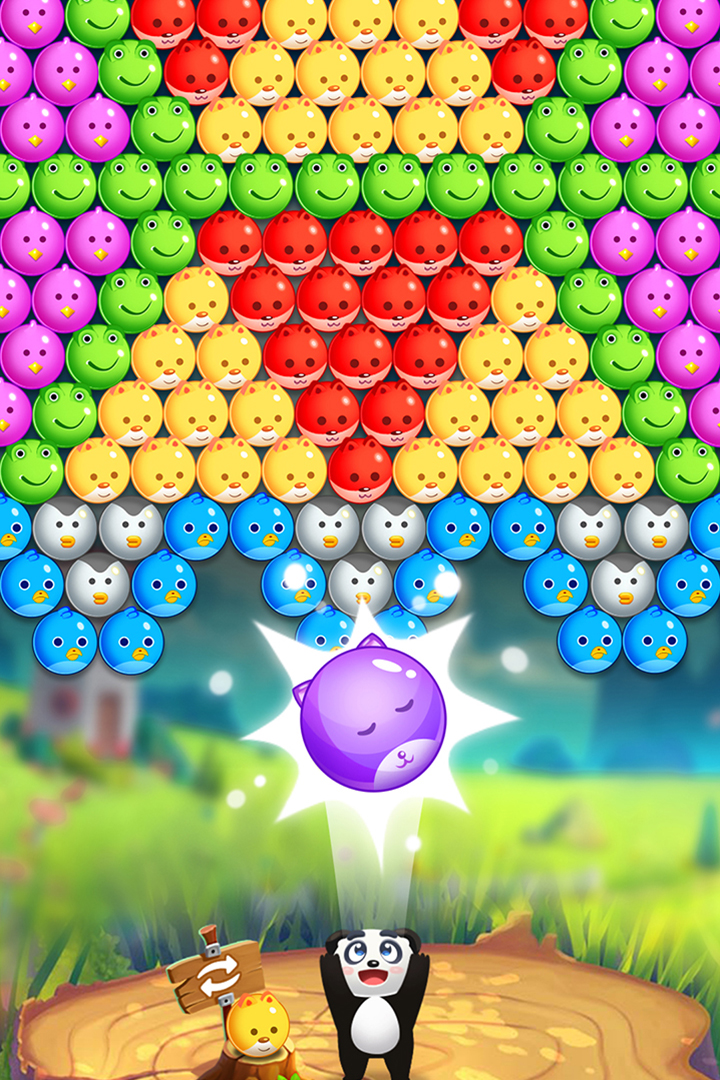
After playing the game for three days and three nights, I ran through the numerical model of the first 500 levels, and used Excel to fit the revenue curve of Sunflower. The conclusion is that this game looks casual on the surface, but actually hides a fairly sophisticated resource circulation system. Want to pass 1600 levels stably? Just relying on your eyes and hands is almost useless, you have to calculate.
Let's talk about the most basic scoring formula first. The base score of each bubble is fixed, but the higher the elimination concentration, the combo multiplier increases exponentially. I actually measured the data from a single match to a six-match match: 10 points for a single match, 25 points for a double match (2.5 times), 50 points for a three-match match (5 times), 90 points for a four-match match (9 times), 150 points for a five-match match (15 times), and 230 points for a six-match match (23 times). In other words, try to save more than 4 before exploding, and your single income can be doubled several times. However, the bubble arrangement in the level is usually deliberately broken up, so the strategy is not to pile them up without thinking, but to prioritize breaking through the edges to create a "domino" chain.
Let's talk about sunflowers. Many people complain that the sunflower appears at random times, but in fact there is a pattern: the total number of bubbles in each level is fixed. When you reach 1/3 of the remaining bubbles, the sunflower will definitely appear in the upper middle of the screen, and it will only be refreshed once. Its function is to consume all bubbles of the same color currently on the field, at the cost of consuming one of your launch opportunities. The best way to use it is: when there are at least 4 or more of each of 3 colors on the field, use sunflower to clear out one of the colors in one go, allowing the remaining two colors to form a dense accumulation, and then manually eliminate them in a chain. I have calculated that this operation can earn about 40% more points and extra props than clicking on the sunflower directly.
Among the three modes, the classic mode focuses on the balance between scores and health, the core of strategy is the step limit, and the infinite challenge relies on time for resources. In strategic levels, the number of steps per level is usually only 15-20, and the error tolerance rate is extremely low. At this time, it is better to waste a step adjusting the position of the bubble than to launch it blindly. My approach is: first observe the top three rows, find the only point that can form four or five matches, use the first shot to tentatively clear the obstacles, and the second shot will truly chain. It has been measured that this "two-beat rhythm" can increase the step utilization rate by more than 30%.
In infinite challenge mode, the score accumulation will not be reset, but the falling speed of bubbles will gradually become faster over time. In the later stages (after about 1000 points), hand speed can no longer keep up with the reaction. At this time, you have to rely on prediction - calculating in advance the rearrangement of the remaining bubbles on the field under the action of gravity after the next launch. I specially recorded 20 rounds of slow playback, and found that after each ball dropped, the bubbles on the left and right sides would preferentially tilt towards the middle, forming a "V" shaped space. If you can leave a bubble of the same color above the apex of the V-shaped void in advance, it will automatically trigger Match 3 after the gravity collapses. This "embedded bomb" technique can save a lot of operations in the later stage.
Finally, there is the cost-effectiveness of store props. In the game, gold coins can be used to buy "color-changing balls" and "bomb balls". The color-changing ball costs 500 gold coins, and the bomb ball costs 1,500 gold coins. I calculated the benefits of using it 100 times: the color-changing ball helps you eliminate 12 more bubbles on average, and the bomb ball helps you eliminate 35 more bubbles on average. Converted into income per gold coin, 0.024 color-changing balls are eliminated for 1 gold coin, and 0.023 bomb balls are eliminated, which is almost the same. But the greater value of the bomb ball is to break the game. For example, a bunch of bubbles are stuck in a blind spot on the field, and the color-changing ball can do nothing. So my suggestion is: save gold coins first for the bomb ball, and only use the color-changing ball for emergencies at specific levels.
Having said so much, the core is actually one sentence: Don't believe in luck, believe in data. Each mode has an optimal solution. Calculate it clearly before taking action. It is only a matter of time before reaching level 1,600.