
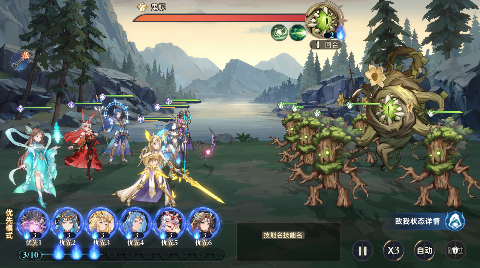
I have played almost 60 ranked games in the past few days, so I would like to talk to you about the PVP environment of this game. Let's talk about the conclusion first: As a card RPG with a 0.1% discount, its competitiveness is more serious than similar products. At least it can be seen that the designer is really thinking about balance issues, but the current version still has an obvious strength ceiling.
The current arena environment can basically be divided into three echelons. The Armor Breaking style with Tang Hao as the core is firmly in T0, there should be no controversy about this. His "one card, two forms" design is too profitable on the offensive end. After switching to the Clear Sky Hammer form, the skill multiplier is significantly increased. With Xiao Wu's pursuit, he can tear apart almost any front row in one round. My own lineup is the standard protagonist team of Tang San, Xiao Wu, and Dai Mubai. When encountering Tang Hao's team with the same combat power, the winning rate is only about 40%. The main loss is in the rhythm-the opponent can explode in the second round, but our control chain cannot be formed until the third round.
The lineup of the second tier is relatively complex. Fire Dance's burning system, Flanders' Hidden Breaking Flow, and consumption teams that rely on Oscar to sustain life can all be played, but they all have a common problem: too much dependence on key cards. For example, Huo Wu needs the cooperation of Feng Xiaotian to produce chain burning, otherwise the output of Huo Wu alone can only be regarded as scraping. This binding relationship increases the depth of the strategy, but it also results in the ban selection process being basically fixed, with only a few cards being tossed over and over.
What is worthy of praise is the design of "one card with two forms", which has indeed brought changes to PVP. When a character switches between defensive and offensive forms, not only the strength of a single card is considered, but also the timing and resource management of the form switch. When I play Dai Mubai in the auxiliary position, I often deliberately maintain the white tiger defensive form to trick the opponent into using a big move, and then switch to counterattack in the next round. This kind of game sense cannot be given by traditional card games. The 334 sets of special effects are not a gimmick, at least the visual feedback when the arena is widened can indeed improve the feel.
However, there is an obvious problem in terms of balance: the benefits of attribute restraint are too strong. At present, the pure agility team's suppression of the pure strength team is too obvious. As long as the dice rolls out the restraint bonus in the second round, there is a high probability of a comeback even if the combat power is lower than 2,000. This kind of randomness will greatly affect the space for tactics in the context of e-sports. After all, the key to defeating the strong by the weak should be operation and operation, not the appearance of the system.
I looked at the matchup data of the king tier and found that Tang Hao's appearance rate in the middle and high tiers was close to 37%, and his winning rate was stable above 53%. This data is considered to exceed the standard in official e-sports projects. It is recommended that when you encounter Tang Hao's team on the way up, you should not be tough. You can either practice fast attack flow to fight for the explosion in the first two rounds, or bring a taunting front row like the Titan Giant Ape to delay the late game. In addition, the planners seem to have noticed this situation. Last week's update log mentioned that the soul bone attributes of some soul masters are being adjusted. Tang Hao's redo plan is probably coming out soon.
As for the suggestions for newbies playing Arena, don't rush to chase the version answer in the early stage. First, maximize the bond between Tang San and Dai Mubai. The upper limit of these two characters is very high, and their ability to hit the backhand with the backhand is stronger than imagined. I myself have been able to gain points stably from the mid-term with this lineup. At least in the current environment, the non-Tang Hao lineup is still capable of fighting.
Overall, the competitiveness of this game is above average among similar games. Although there are still balance flaws, it can at least be seen that the designer is seriously working on the battle framework and is not just mindlessly stacking combat power. For players who like strategy cards but can't stand the pressure of traditional PVP, it's worth a try. If Tang Hao's redo is implemented in the future, the environment will probably be reshuffled. I will talk to you again then.