
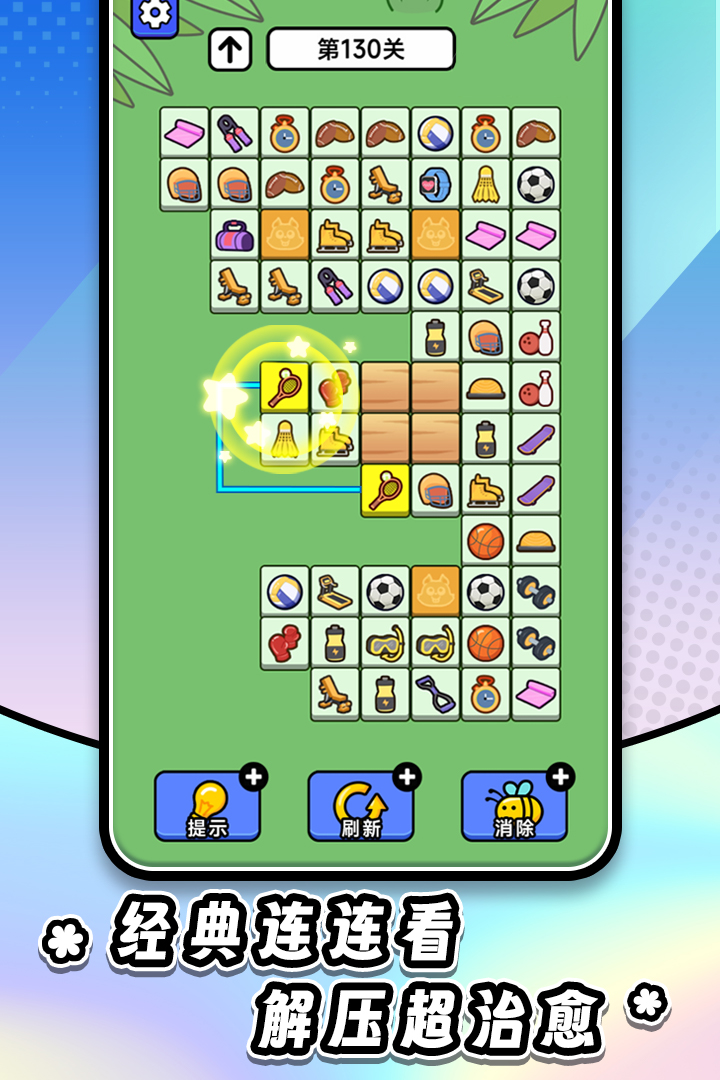
Traditional Lianliankan focuses on eyesight and hand speed, and is essentially a stand-alone reflex training. But after the game introduced obstacle mechanisms such as stone bricks, ice blocks, and vines, the situation became a problem of resource management and route planning. Stone bricks cannot be moved or eliminated, which means that you must plan at the beginning stage which areas are "dead zones" and which connections will take long detours; ice blocks need to be eliminated adjacent to each other, which directly changes your priority judgment - should you break the ice first to open the path, or clear the surrounding area first to pave the way for the follow-up? This kind of decision-making layering already has the prototype of "operation" in competitive games.
What's more critical is the bee props and refresh mechanism. Bees can assist elimination, but in a confrontational context, they are a "tempo shifter." When to hold it in your hand and not use it, and when to throw it out decisively to disrupt the opponent's cleaning rhythm. This is a typical psychological game. Refresh is the same, betting on the distribution of cards in the next round, much like "checking the cards to find the key card" in the card game. In the later levels, where the intervals are getting shorter and the blocks are arranged more and more tricky, every step is a competition with the optimal solution, rather than simply competing with who can click faster.
If a real-time battle mode can be added in the future, such as competing on the same screen to see who can clear the game first, or throwing stone bricks/vines at each other to interfere with the opponent's board, the competitive depth of this game will be fully supported. The vertical screen layout is also suitable for fragmented black games, one or two minutes per game, and the feedback is direct. As a stand-alone game, the current version has adequate strategic concentration; but what I value more is the "seeds of confrontation" it has planted under the elimination framework.
What Shenyang Zongyi did this time was not to eliminate the fun without thinking, but to lengthen the "causal chain" of solving puzzles. For mobile gamers who like to use their brains outside of operations and study version rhythms, this game is worth putting on the watch list. Waiting for a battle mode, maybe it will be the next dark horse of casual e-sports. 🧐