
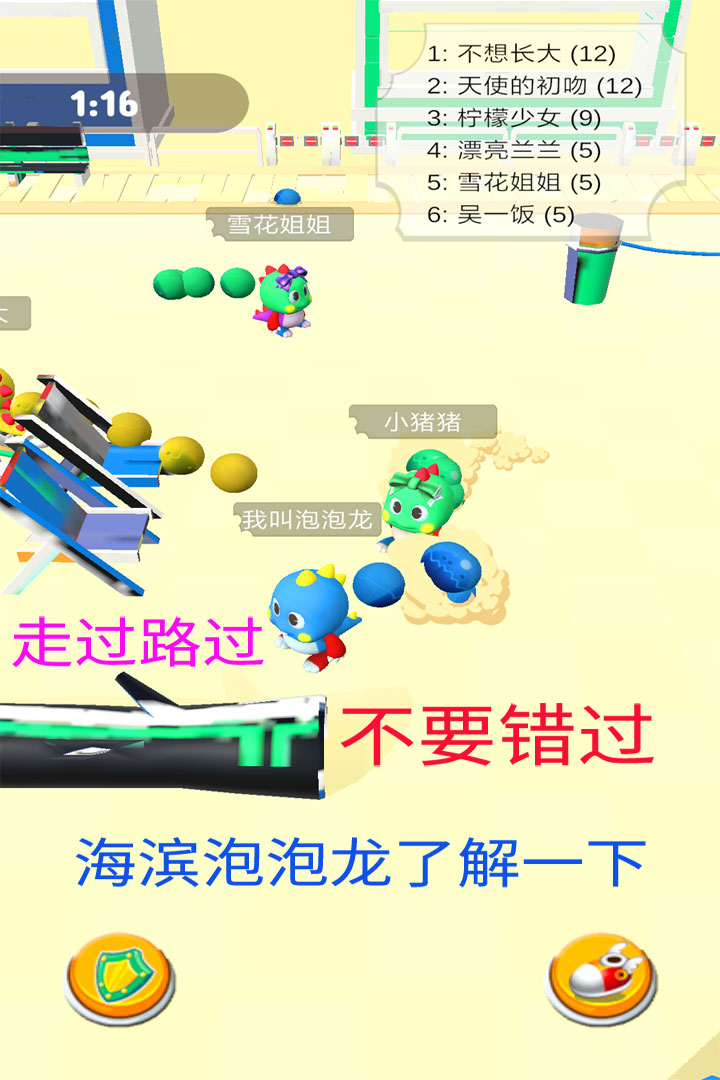
I've been diving a lot in the game sharing section lately, and I've seen a lot of people discussing the upper limit of casual games. I just happened to be trying out a mobile game called "Seaside Bubble Bobble" in the past two days. After playing dozens of games, I feel that the competitive potential of this game is worth talking about than imagined.
Let's talk about the core gameplay first. The essence of the game is a huge battle for resources. A group of cute dragons are looking for and eating balls on the beach, competing to see who can eat more. Sounds simple, right? But in actual play, there are actually a lot of game points in it. The most direct one is the ball-grabbing mechanism. You have worked hard to save the ball for most of the way, and a dragon from the opposite side wanders over and directly intercepts it. At this time, your decision-making is very critical. Whether to choose to take a safe way to go around or to fight hard to get it back, every step affects the situation. The operation of avoiding obstacles also requires immediate reaction. One mistake may cause debuffs or slow down the rhythm, and the opponent can take advantage of this gap to widen the score gap.
From a tactical perspective, one of the more interesting aspects of this game is the understanding of operational rhythm. Because the number of balls eaten determines the outcome, the action route of each dragon is actually particular. Going to the wing is more efficient but also risky. Going to the middle is safer but resources are relatively dispersed. How to establish a ball advantage in the early stage and still maintain the survival rate requires judgment from a global perspective. This is not common in current light competitive mobile games. Many times these games are just mindless, and whoever clicks faster wins. Beach Bubble Bobble has worked hard on this.
Then praise its confrontational feedback. There is clear visual feedback when the ball is grabbed, and the increase or decrease in the number of balls is very intuitive, which provides players with a lot of information to judge the situation. Only when you can see the gap can you know whether to be aggressive or conservative in the next step. This clear confrontation feedback mechanism is the basic skill of competitive games, and many leisure products are weak in this area. The Seaside Bubble Bobble surprised me a lot.
I also want to mention the version. I am playing the current version, and the current refresh distribution of the ball is slightly even. In the master game, it is not easy to gain the advantage in the early stage, and it is very common to delay the comeback in the later stage. This is actually helpful for viewing, but if the official does more to differentiate the characters in the future, such as allowing each cute dragon to have different skills or different basic attributes, the tactical depth can be further improved. This is purely an expectation as a player who cares about balance. After all, the longevity of competitive games depends on version iteration and balance adjustments.
In general, Seaside Bubble Bobble is a free mobile game. It is based on a qualified casual competitive type. The basic framework of eating and grabbing balls and avoiding obstacles has already formed the prototype of a brawl game. The threshold is low, it is quick to get started, and the confrontation feedback is intuitive. It is suitable for players who like a competitive feeling but don't want to be too aggressive. If you usually watch KPL and LPL too much, and occasionally want to play for yourself, this game can satisfy a little competitive desire in your spare time. If rankings or ladders can be added to the competition mode in the future, I think it will really have a chance to go in the direction of light e-sports. 🧐