
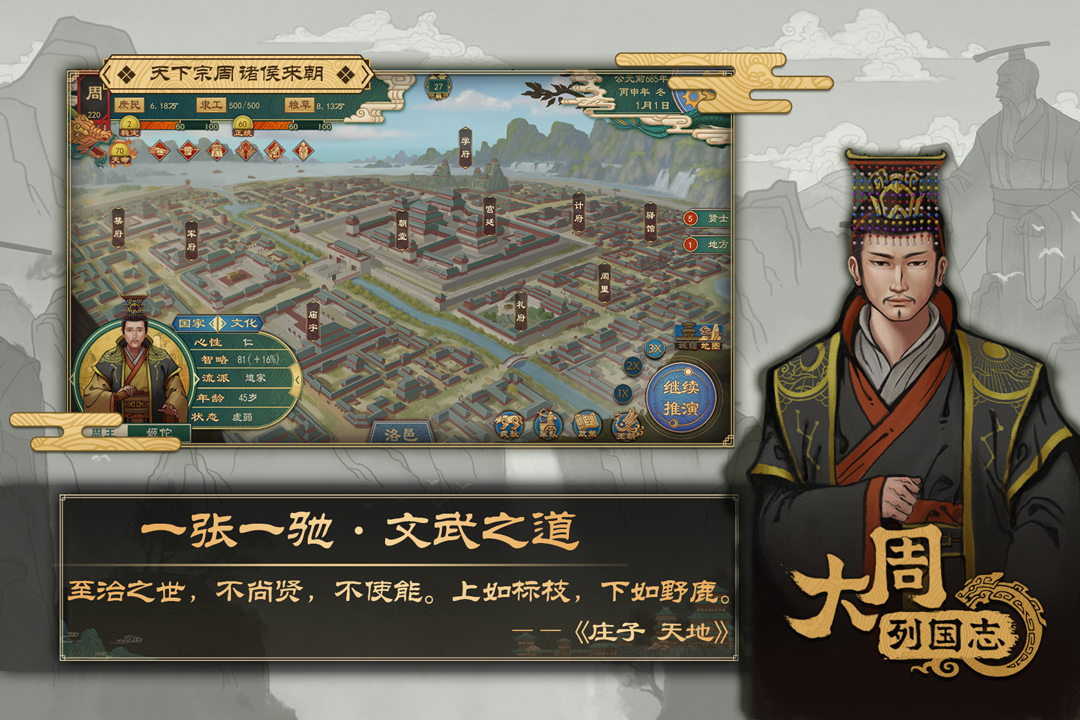
Let me talk about my own situation first. I usually watch KPL and LPL a lot, but I am quite picky about MOBA and tactical competitive games. But I discovered an interesting phenomenon. Recently, in the e-sports circle, many people have begun to discuss historical strategy games. So when a friend recommended this game, "The Chronicles of the Great Zhou Kingdoms", my first reaction was that the span was a bit big, but after actually experiencing it, I found that it does have some hidden competitiveness.
Let's talk about the background setting of the game first. "The Chronicles of the Kingdoms of the Great Zhou Dynasty" tells the story from King Wu's defeat of Zhou to Qin's destruction of the six kingdoms. The entire history spans nearly a thousand years. This is somewhat similar to the e-sports events we usually watch. Each version update is a "dynasty change", and different versions of strong tactics are equivalent to hegemony modes in different periods. Currently in the game, you can choose to start from the era of peace in the early Western Zhou Dynasty, or you can jump directly to the chaotic times of the Warring States Period. There are many choices and you will not get bored.
In terms of strategic depth, this game is not a simple "dot-dot" simulation business. It must have domestic and diplomatic means, and it must also find ways to deal with multiple forces. If you look at it as an e-sports game, it actually means that while you are operating a side lane, you must also pay attention to the trends in the middle lane. Internal affairs is equivalent to your development and operations, while diplomacy is your BP game and exchange of resources within the game. The rhythm of the whole game is: operation is the foundation, but the key still depends on how you make decisions at critical moments.
And I noticed that each vassal state in the game has different characteristics and geographical advantages. This reminds me of the hero restraint and lineup matching in e-sports competitions. For example, if you choose a small country in a corner, you must first figure out how to survive in the cracks. Diplomatic strategy is particularly important. If you choose a big country, you will have more resources, but there will also be many enemies around you, so you need to find a good balance between expansion and defense. This is very similar to the different team styles in the professional arena. Some teams win by operation and late-stage development, while others rely on early fights to snowball the advantage. Choosing different countries means choosing different tactical systems.
Be sure to mention the balance of the game. As an e-sports observer who often thinks about version balance, I think "The Chronicles of the Great Zhou Dynasty" is more careful in this regard. Although there are differences in the strength and weakness of various countries, there is no completely unsolvable strong force. Players can make up for the initial disadvantage through strategic operations, resource allocation and diplomatic means, which ensures the diversity of tactics. Just like MOBA, no hero has a 100% winning rate, and no country is absolutely invincible. Each version has its core gameplay.
I have tried several development routes, one of which is to take the "Road of Overlord", which relies on military power to expand rapidly in the early stage, destroy all the surrounding small countries, quickly accumulate national power, and then form an overwhelming advantage in the mid-term. There is also a style that favors the "Emperor's Road". In the early stage, you can develop domestic affairs with peace of mind. After you have more cities, you will start to join forces vertically and horizontally, and use diplomatic means to gradually eat away at your opponents. Both routes can be played well, and it tests the overall situation. It is not the kind of game where you can get to the bottom of the game with one trick.
From the perspective of competitive potential, I think the biggest highlight of "Great Zhou Kingdoms" is the possibility of multiple people competing on the same map. If you organize players in a server to play on the same large map, the feeling of competing among the heroes will be more exciting than the hegemony mode of many e-sports games, because it involves diplomacy, offensive and defensive alliances, and long-term strategic planning. This is the most attractive thing in e-sports competitions. I'm still looking forward to how the gaming community will tap into this potential in the future.
If I am a bit worried, it is that the entry barrier for this type of game is indeed relatively high. Newcomers who have just entered the game may be a little confused by the complex diplomatic system and resource scheduling. But this is also a characteristic of historical strategy games. Just like when you watch the BP link of a MOBA game for the first time, you may feel that many hero names are unclear, but after watching it for a long time, you will realize the undercurrents. Once you get started, you can feel the feeling of strategizing.
All in all, if you are the kind of person who likes to use your brain and strategic duels, and you happen to be interested in history and culture, you can really consider giving this game a try. We are usually accustomed to competitive games with fast operation and fast pace. Sometimes, switching to a slow-paced strategic battle is actually quite enjoyable in terms of thinking. And I always feel that if a game has enough strategic depth, then to a certain extent it has competitive genes, but the form of expression is different.
Personally, I plan to open a few more countries in the new area to try out different opening styles to see if I can find an operating route that suits my own rhythm. If there are veterans in the forum who are also playing this game, welcome to chat about the opening operations and various tips. After all, in strategy games, the collision of ideas may be the key to victory. 🀄️🎮