
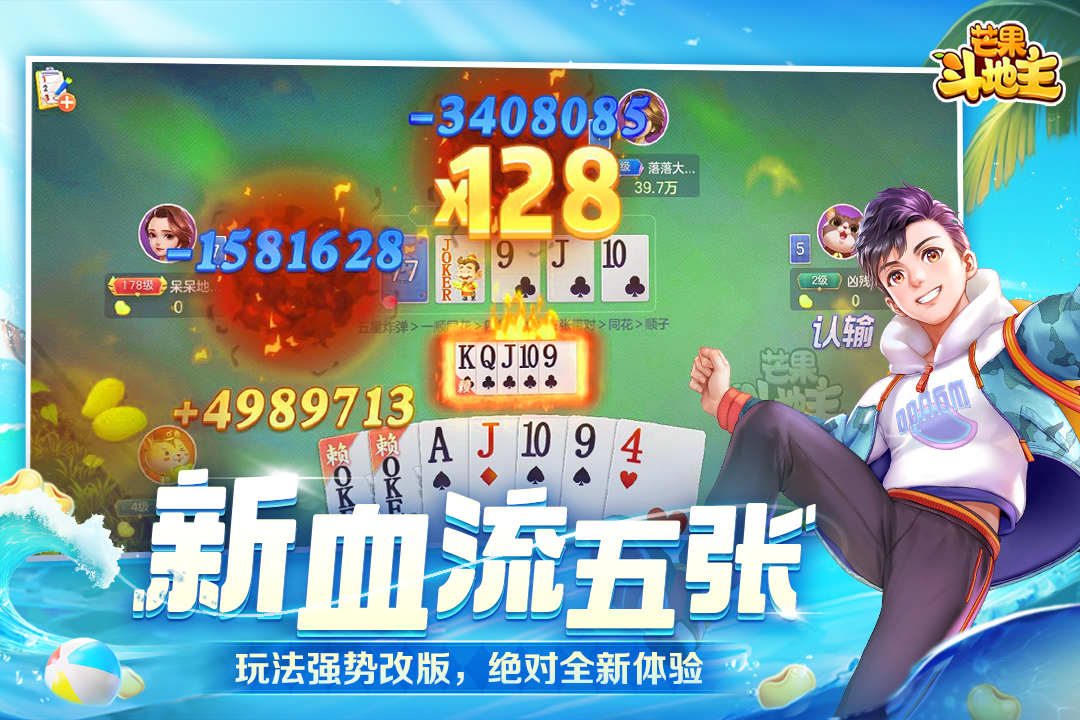
Let me first state that I only entered the game because I could count cards and play games. This game seems to be casual, but in fact the numerical logic of the card types is more rigorous than imagined. After playing for three seasons, I will give you a few core pitfalls. If you follow the steps, the rhythm of scoring can be much more stable.
The first step is to call the landlord and grab the landlord. Don't just look at the strength of the cards in your hand. My personal data threshold is this: with double kings or two twos in hand, plus any bomb, the landowner's expected profit from his trump card is just above the passing line. If there is no king or two, but there are two or three bombs, you can bet on the hole card to make up two. All straight cards are of the same color. Unless the cards are extremely straight, don't grab them. There are too many uncertainties in the three hole cards.
In the second step, many people ignore the calculation of doubling opportunities. I have done some calculations and found that the opening hand has a king plus four twos, and the theoretical winning rate is over 70%. If it is doubled at this time, the profit expectation is positive. But if you only have a two and no king in your hand, you should be calm when the opponent grabs you, and stop loss is the best solution.
The third point is the most important, the defensive logic of Leizi's gameplay. Many people naturally like to gather bombs, but the core value of Leizi is to control the single card and the second card in the second half. My habit is to give priority to leprosy and not to use it until the endgame, when it can be used as a wild card to break up pairs or make up straights. For example, in the end game, if you have 468 cards left in your hand and a leper, don't try to join in the explosion at this time, just remove the leper and make up for it. If there are fewer rounds of card play, the opponent's initiative will be suppressed.
Another thing is that in the classic model, information between farmers is as clear as possible. When conveying the card ownership signal to your teammates, play the smallest card first to let your teammates understand the structure of your cards. I have made statistics myself. In a game where information exchange is smooth in the first two rounds of the game, the farmer's winning rate can be close to 60%, which is much better than playing cards randomly. The teammates had a bright card advantage but couldn't hold it in. They encountered real blood pressure several times.
Regarding the Q version style and emoticons, to be honest, I thought they were gimmicky at first, but after looking at them for a long time, I found they are useful for psychological warfare. If the opponent's rhythm slows down and the opponent clicks their expressions frequently, it is probably because the card structure is not smooth. At this time, the opponent will take the initiative to double the pressure, and the opponent's probability of making a mistake will increase. This is my own summary of the hidden value. The data is not accurate but the physical feeling is quite effective.
Finally, I want to mention that this game has good social linkage. The biggest advantage of inviting friends to play black together is not to chat, but to cooperate with the fixed team to run into the logic of passing cards between farmers. It is important to sit at the top and bottom of the table with your friends. In my fixed team, people with good memory sit down to make it easier to deduce the hand structure from the order of playing cards.
That's probably it. The core is still the probability of card types and the management of the order of playing cards. The foundation of Mango Landlord is very orthodox. Don't be fooled by the style of painting. If you calculate it carefully, you can play it very deeply. If you have any detailed questions, please leave them in the comment section and I will reply when I see them.