
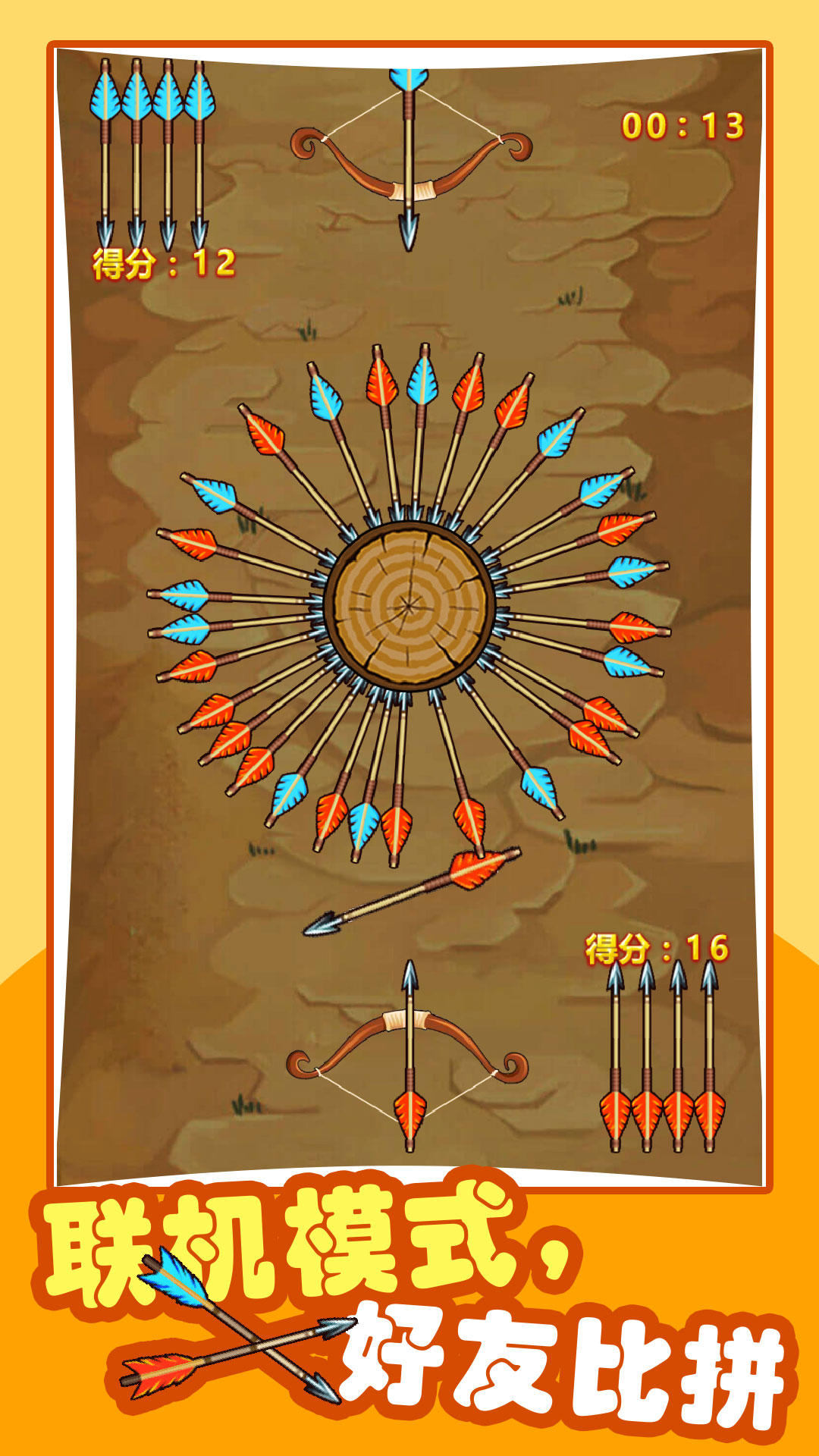
I tested this game for three days, from the first level to more than 300 levels, and died no less than 500 times. I finally figured out this mechanism. Let's talk about the conclusion first: The Chinese version of AA appears to be a casual game, but it is essentially a rhythm calculator. If you think of it as a mindless clicking thing like Happy Bubble Cat, I'm afraid you'll have to smash your phone after a hundred levels.
Let's talk about the basics first. Dual modes, sneaking in every opportunity and turning around, adding up to more than 400 levels, free, no in-app purchase traps, the developer is Multi-bit, the physics engine of this factory is well adjusted, the rotational inertia of the needle is more realistic, not the frivolous paper feel. The running platform is Android 5.0 and above, and it can also be used on older models, which is a good thing.
Focus on the operating logic of the exploit mode. There is a turntable in the center of the screen, with needles popping out around it. If you click on the screen, the needles will be inserted. The core question is: where to insert and when to insert.
The most common mistake that novices make is to attack wherever there is an opening, and to rush when they see a big gap on the turntable. This is not right. Every time the turntable makes one revolution, the frequency of gaps appearing is different, and when the needle is inserted, it will cause a slight angular velocity disturbance to the turntable. The denser the needle is inserted, the more outrageous the superposition of the disturbances will be. In the later stage, the entire disk will rotate like a convulsion.
My suggestion is to ignore the gap size at first and count the RPM first. The rotation speed is fixed for the first thirty levels. You count the intervals between a certain mark point on the turntable and the twelve o'clock direction. If you insert the pin according to this rhythm, the success rate can be over 90%. After level 30, the speed starts to change. At this time, you need to rely on prediction-note that it is prediction, not reaction. You have to stare at the point where the needle tip is about to touch the disk, and press it three-tenths of a second in advance so that the needle just clicks into the gap when it lands. Practice it a few times and your hands will memorize it.
Then comes the choice of seam. Some people say that you should only choose drills with large seams, which is wrong. The large seam is usually followed by a small seam. After inserting the large seam, if the angle of the turntable is tilted, the small seam may be thrown away. My experience is to insert narrow gaps first, because the time window from the appearance of the narrow gap to the next available position is longer, which makes it easier for you to adjust your rhythm. Moreover, after the narrow slit is inserted, the disc surface will be more disturbed. On the contrary, this disturbance can be used to swing the subsequent slit to a convenient position for you. This is not metaphysics, but perspective.
The mode of turning around and eliminating music is a completely different set of ideas. In that mode, the needle becomes an elimination tool. You have to use the needle to poke blocks of the same color. Only blocks of the same color can be eliminated. Hand speed is not the key in this mode, eyesight is. First, scan the entire board to find the densest areas of the same color. Prioritize the elimination from the center outwards, because the blocks on the edges will not interlock after elimination, and the blocks in the center will collapse in a circle once eliminated. There is also a little trick. When the direction of rotation is clockwise, if you poke from left to right, the hit rate will be higher than if you poke straight, because the parabolic trajectory of the needle exactly matches the direction of rotation of the disk.
Among the more than 400 levels, there are a few hurdles that I have to mention separately. Level 89 is the first point to persuade people to retreat. The turntable is double-layered, with the inside and outside rotating in opposite directions, and gaps appear staggered. You can only focus on the outer layer, and scan the inner layer with your peripheral vision. Don't expect to pass this level with three stars, try it first and get familiar with the feeling of double-layer reverse. The one hundred and seventy-seventh level is even more abnormal. There is a fake gap on the disk, which looks empty. If a needle is inserted into it, it will immediately fail because it is a visual projection. How to tell? The edges of fake gaps have fine jagged edges, while real gaps are smooth. I haven't mentioned this in many guides, so I guess I didn't suffer this disadvantage.
Another little tip, the timing of inserting the pin is actually linked to the beat of the background music. The BGM rhythm points built into the game are not written randomly, they are synchronized with the turntable speed. Turning up the sound and following the beat is much more effective than staring at the screen. I tried playing with the sound turned off, and the success rate dropped by at least 20%.
Finally, let's talk about hardcore. The insertion depth of the needle will affect subsequent judgments. If it is inserted too shallowly, the needle tip will only be inserted halfway, and the needle will be thrown out when the turntable rotates to a large gap; if it is inserted too deep, the needle tail will hit the needle behind it. The optimal solution is to make the needle tip just past half the thickness of the disk, which is stable but not in the way. How to control?Don't press down as hard as you can, and release it quickly after clicking. The needle will have a natural rebound, and this rebound distance is exactly half the needle depth. Once you master this feel, you will have more room for error than others in later difficult levels.
Generally speaking, this game is the type that gets more interesting the more you play it. The first hundred levels are teaching, the middle hundred levels are advanced, and the last one or two hundred levels are completely a battle of calculation and mentality. I usually take it out and go through two levels while waiting for the bus. It is very stress-relieving. It is not recommended to use it for too long at one time because it will feel dull. I finished it in three days and took a break every half day before continuing. The efficiency is obviously higher than that of continuous use. Okay, that's it, the rest is up to you to figure it out on your own. I wish you all will clear the level as soon as possible, and don't ask me how I played after 300 levels. I really don't want to touch the fake gaps in that level again. 😅