
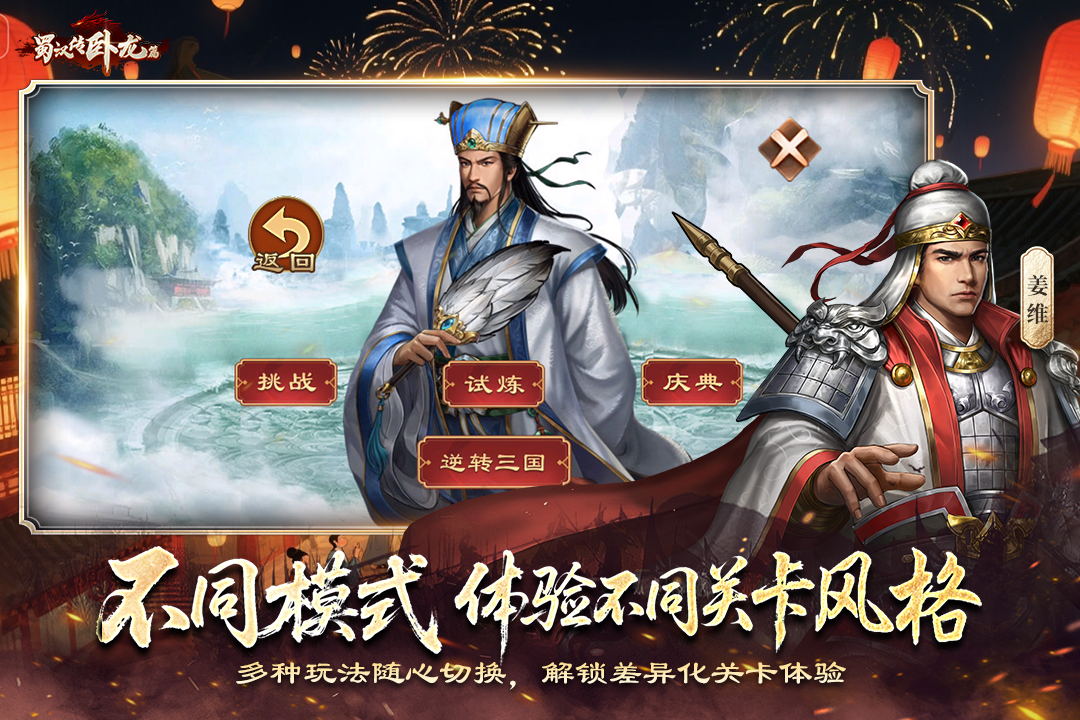
Let's talk about positioning first. This game is not a strong confrontational competition like mainstream MOBA or card battle. Its “competitive feeling” is more reflected in the extreme strategies of PVE levels and the game of ideas of lineup matching. The two scripts of Liu Bei and Wo Long naturally form two completely different rhythms, which is very interesting. The resource acquisition in the early and mid-term of Liu Bei's chapter is relatively abundant. The high-explosion physics of Guan Yu and Zhang Fei will be very powerful. The picture pushing experience is smooth, which is suitable for players who pursue a sense of exhilaration. In the Wolong chapter, due to the storyline locking the lineup, the spell suppression system with Zhuge Liang as the core has become the mainstream, and the requirements for control of positioning and skill release timing are much higher. This is completely different from the reckless play style of the previous chapter.
Let's focus on balance. The charging model of this game is 0, which means it is free, which makes its development line more dependent on version understanding and resource planning. At present, it seems that the core generals (such as Zhuge Liang) given in the main line are strong enough, and they will not be completely stuck without spending gold. But the problem is also here: the numerical growth curve of enemies in later levels is slightly steep, especially in the Northern Expedition of Wolong Chapter. The opponent's spell resistance is generally high, causing the income gap between physical flow and spell flow to be widened at certain nodes. This is considered a small imbalance, but the official subsequent patches are making fine adjustments.
From a tactical analysis perspective, the most brain-burning part of this game is adapting the historical events of the Three Kingdoms into battlefield conditions. For example, the "fire attack" mechanism in the Battle of Chibi level does not simply pile up damage, but changes the battlefield terrain according to the wind direction, forcing you to re-plan the sequence of actions at each step. This design gives PVE itself a sense of fixed confrontation similar to problem solving, which is very similar to the logic of lineup restraint and rhythm exchange that I saw in KPL.
To sum up, if you are looking for a mobile game that is not overly demanding but has room for in-depth tactical research, this game is worth trying. Its balance is not perfect, but it is better because there are more game dimensions, and there is no frustration like mindless numerical crushing. Moreover, the plot from the perspective of Shu Han is very immersive. After playing it, you will be particularly sensitive to the "choices of each round". This is probably the real charm of strategic war chess. 😏