
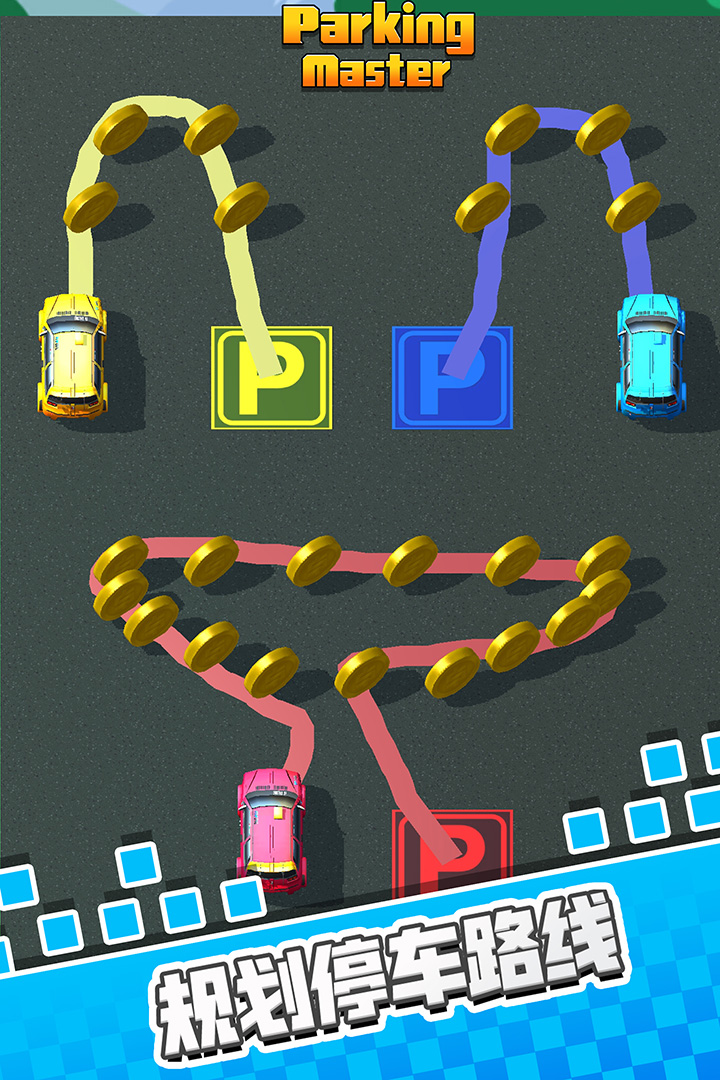
Let me talk about the conclusion first: This game seems to be about free line drawing, but the core is actually a path planning problem. Don't be fooled by those fancy car models. In the final analysis, it's "calculate the path backwards from the parking space, and then use the vehicle width to verify the distance." Understanding this will save you a lot of trial and error time.
Before jumping into the pit, let's clarify a few underlying mechanisms. The movement of the vehicle is automatic, and the line you draw is the only landmark. The vehicle will keep walking along this line until the line ends or it hits an object. There is a setting that is easily overlooked here: the car moves according to the "center point line", not the body. Drawing a line close to the wall seems to be too much, but the rear of the car hits the obstacle and fails. The reason is that you forgot the width of the car.
Regarding the position of drawing lines, first remember this iron law: the width of the vehicle body is equal to the invisible safety bandwidth of the path. The width of each car in the game takes up about a quarter of the screen width. If the line you draw is too close to a wall or other vehicle, a collision will be determined as long as it is smaller than this width. A safe approach is to draw the line in the center of the open area as much as possible, and leave at least half a visual margin of more than half the car body when the edge needs to pass.
Let's talk about the reverse deduction method. This is the core idea to solve all obstacles. The correct sequence is to first find the target parking space, draw a virtual extension line from the opening of the parking space outward, observe where the extension line can turn and whether it will block the road, and then try to see if the extension line can be connected from the front of the car. Most of the levels are difficult to pass because players are used to drawing lines from the front of the car forward. Only in the second half of the game do they realize that they can't turn around and have to regret it and start over.
Some small mechanisms in the level require special attention. The moving roadblock will have a fixed circular trajectory. If you find it walking around, the easiest way is to wait for it to reach the point farthest from the parking space, immediately start the vehicle, and walk around it in an arc. Remember not to rush for time by drawing straight lines. There is no time limit in this game. If you can use a curved line to pass safely, don't draw short straight lines too quickly. In addition, some sections marked with arrows are one-way roads with direction restrictions. The direction of the line drawing must be consistent with the arrow. If you draw it in the opposite direction, the system will prompt failure, so don't be rigid.
Regarding the timing of using the brake, many players underestimate it. The end point of the line drawing is actually the final stopping point of the vehicle. When the line end is left in the middle of the road, the car will stop, which can be used as an intermediate buffer. When encountering a map with continuous turns and complex intersections, it is recommended to divide the route into two sections: in the first section, lead the car to the safety platform area, use a thread to stop it, and then draw the second section to connect it. This approach is very effective for ultra-long distance levels. The car will not have route fluctuations in the middle because a line is too long. There is a detail here, which is the difference between the two painting methods: the route to the end of the one-stroke painting is continuous, and the car will maintain a constant speed; the segmented painting will slow down and start again, but the result is extremely stable control. In situations where it is necessary to accurately fit the parking space and there are cars all around, it is recommended to draw in sections.
Let me add another hard-core disassembly case, the seventh level with the parking lot theme that I have been stuck on for a long time. The map shows a double-decker truck on the left, three cars side by side in the middle, and a large open space and two parking spaces on the right. The standard solution is to draw an S-shaped passage on the first floor for the truck on the left and turn into the second floor. Because the truck body is long and the turning radius is large, the path arc should be drawn slower and the transition line should be deliberately extended at the corner. Don't try to turn at a right angle, as the long car body will get stuck directly on the beams and columns. The three cars in the middle are simple. They only need a downward arc to pass through the gap with the largest distance between the two cars. Pay attention to pressing the end of the thread exactly in the center of their respective parking spaces. If it is a little off, the front wheels will be aligned but the rear of the car will rub against the car next door.
Let's talk about the differences between models. There is a big difference in the cornering feel between a car and an SUV. The car body is short and flexible, suitable for extremely thin turns. The SUV body is long and bulky. When drawing the line, you need to start turning one parking space in advance so that the front and rear of the car can stay within the path.Some levels force you to use an SUV to negotiate continuous turns, which is basically a test of whether your "advance amount" is accurate enough. For levels where two cars exit at the same time, try to have the two cars take symmetrical or complementary routes to avoid a line crossing the other car's only path. If there is no need to merge, follow the "first-come-first-served principle" and let the first car go away first, and then let the second car come on line in the second half of the journey.
There is another mechanism that is easily overlooked: collision determination is not instantaneous, but is calculated in real time as the vehicle passes by. This means that if the front of the car passes but the rear half of the car hits any parked car when turning, it will still fail. The author has actually measured that when cutting corners in a narrow position, the safest angle is to keep the path and the edge of the obstacle at a 45-degree angle and cut diagonally, rather than cutting vertically. Cutting vertically can easily cause the rear of the car to fall into the obstacle area.
Finally, let me tell you a little mental tip: This game really leaves players with unlimited room for error, so don't rush to deny your ideas any time you fail. What you have to consider is “whether a certain bend was drawn too tight” or “whether the line just left was not enough in advance.” Treat each car as an independent piece of geometry and each path as a pipe with width, and your problem-solving ability will directly go to the next level. Don't be superstitious about a fixed answer to the level. Master the width of the car body and the curvature of the path, and you can figure out the remaining levels by yourself.
The number of officially released levels is enough for you to play for two weeks, and the update frequency of subsequent versions is also relatively stable. When you encounter a particularly tricky position during the passage, you will often come up with new ideas if you stop for a while and come back to look at it. Although the game is small, the geometric fun is really not fooling people. After playing it, you will find that there are so many ways behind drawing lines. I wish all friends who are stuck can park every car clearly in this chaotic parking lot as soon as possible.