
Let me draw a conclusion first. Although this game is a stand-alone casual collection under the banner of childhood feelings, it actually has a strong competitive foundation. I am usually used to watching the fierce head-on collisions between KPL and LPL, but when I play a small game like this, I feel that some of the details in it are quite particular.
I tried the six modes one by one. The first one I want to talk about is the drop mode. There is nothing to say about classic Tetris. The problem is that it gives players a particularly pure competitive cycle. The uncertainty caused by random block sequences is actually the same as critical hits and misses in MOBA games. European and American competitions often say that "luck is also a part of strength." In block games, masters can use fault tolerance to hedge against bad sequences. This has a sense of version understanding.
What I like more is the push-up mode. This innovation turns the passive elimination of traditional Tetris into an active occupation game. What you need to consider is not only eliminating rows, but also blocking positions and blocking roads so that the blocks have to go higher. It feels a bit like grabbing the resource group in King of Kings. If you manage a positional advantage, the opponent will suffer a loss. If this mode is made into a two-player battle on the same screen, it will definitely be very entertaining and strategically in-depth.
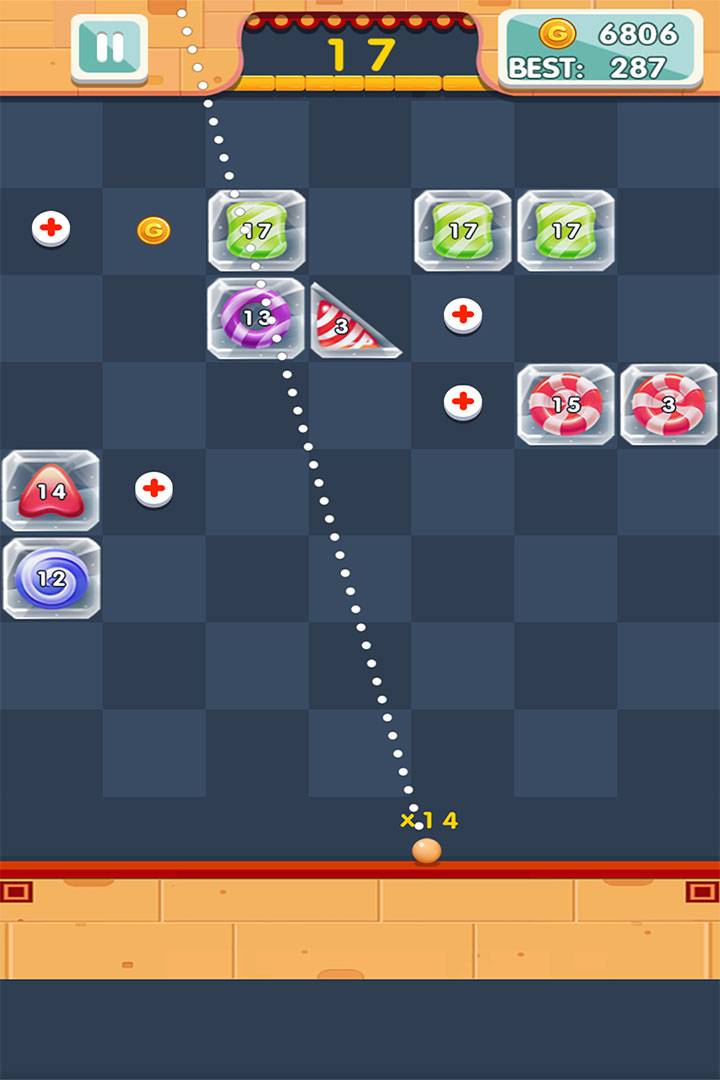
But to be honest, there is one point in the balance that makes me quite uncomfortable, and that is the dancing marbles. This mode is really cool, but the difficulty curve is a bit steep. The first few levels are like a training camp for fighting against humans and machines, but in the middle, it suddenly becomes a version T0 level BOSS. The growth value span of the ball speed is too large, the determination of the ejection angle is not uniform enough, and luck accounts for nearly half. It's like if you play a strong hero, the rhythm in the early stage is smooth and there is no solution. Once the equipment is formed, you can't touch the team at all.
Rhythm bricks are relatively more stable. I carefully compared the five brick-breaking modes, and the difference in mechanism can be felt. The classic mode requires predicting the rebound trajectory. This is a hard operation without any shortcuts. It is the real technical ceiling in this collection. Compared with marbles, the vertical response and accuracy requirements of players here are higher, and random factors are suppressed to a minimum, and the competitiveness is indeed online.
Pet star elimination and pet continuous elimination are relatively mild. But don't underestimate the design of these two modes with hundreds or thousands of levels. It actually tests the player's ability to recognize spatial structures and combined graphics. With more than 1,000 levels of continuous matching, the level design is easily repetitive, but the rhythm of the distribution of different cute pets can still be seen as a bit of planning - from the requirement to only find the same pattern, to the later stage, you must consider in advance whether you can naturally eliminate the remaining grids, which is no less mental-consuming than the countdown in Go.
In addition, I would like to praise its zero-charge design. There are no invisible payment points in the entire game that force you to unlock levels or temporarily renew your life, nor is there any attribute suppression like in PVP where "you pay and you become your father". To put it bluntly, the first condition for fair competition is that all players stand on the same equipment panel. In this regard, it achieves something that many so-called e-sports games fail to do well. Relying purely on technology, proficiency, and on-the-spot problem-solving ability to separate levels, it couldn't be more upright.
Finally, let's talk about the operating environment. This game does not require version updates to adjust values, because its core mechanism itself is old and classic, and replayability depends on people's challenge threshold. As a mobile gaming pastime, it's really clean. If the modes are divided into multiple small competitions, the drop mode is the standard competition system, the rhythm bricks are personal shows, and the push mode is suitable for 2V2 confrontation. Each rule can trap player groups with different preferences. This is actually a natural environmental tolerance.
Of course, the UI is indeed a bit outdated, and the developers are far from proactive in optimizing screen adaptation. If you run on Android 5.0, you have to accept its ancient UI aesthetics. But this is not a flaw at the competitive level, and it does not affect the fairness of the core gameplay and the process gaming experience. Overall, it is a box of cold cuts with very solid ingredients, not a gourmet meal, but if you are willing to sit down and chat about the operation and strategies, it can definitely accompany you for a very immersive time. 🧩
I hope to see someone make an online battle version of the push mode in the future. I will be the first to sign up to participate. 😄