
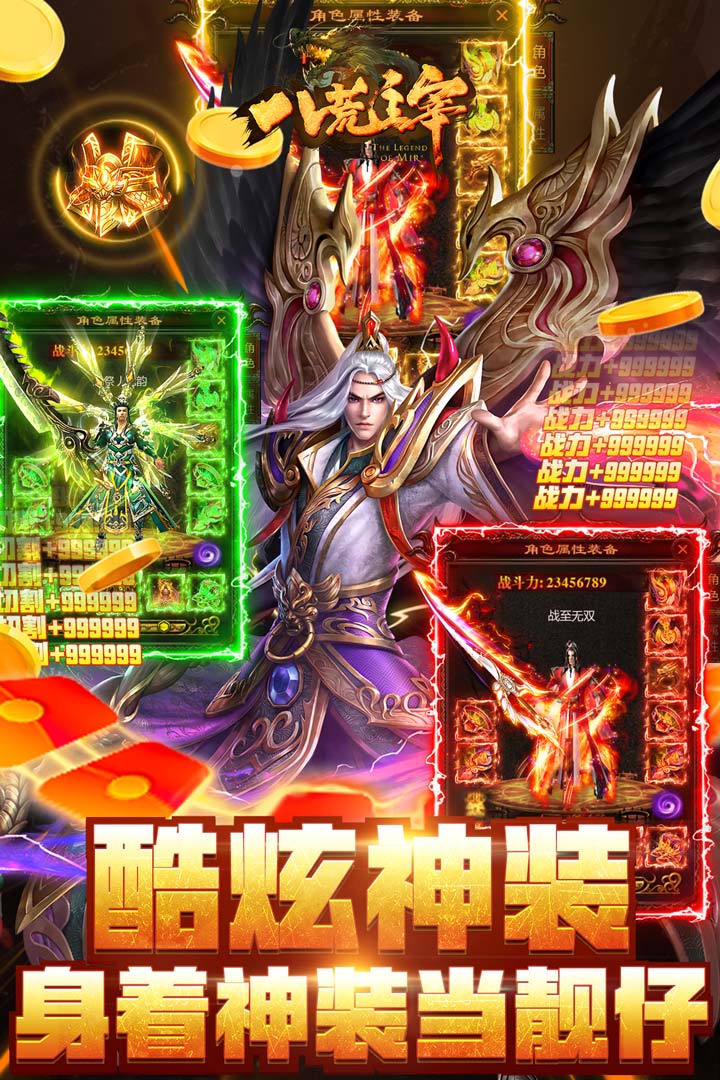
At first glance, this game looks like a classic three-career MMO with an iron triangle of tactics, but when you actually play it, you will find that its development lines are quite deep. The setting of Yuan Shen can be regarded as making the numerical value work better. As the state of Yuan Shen rises, the percentage bonus is directly fed back to the damage of hitting people, and more importantly, the Yuan Shen inherits the protagonist's attack power. In other words, even if you are a blank slate, as long as you pull up your soul, you can still compete with others. This design is actually quite particular when placed in an arena.
But when I look at this version, the biggest change is the introduction of the two lines: Medal of Legend and Soul of the Dragon. These two newly added systems are not only tools to increase combat power, but also allow you to unlock demon warriors and spirit gun clones. This is a bit interesting, as it adds another layer of variables to the battle logic. In the past, the battle between the three professions was basically about positioning, skill prediction and resource exchange. Now that there is an additional clone joining the battle, the entire output rhythm has completely changed. Especially when the spirit gun clone comes out, it will instantly create a situation where one more player is fighting when fighting in a group. This will begin to test your judgment of the fighter and the details of the operation.
My personal feeling is that version updates have a very obvious impact on professional strength. Take warriors as an example. In the past, they just entered the field and launched a wave of resistance, but now because of the superposition of percentage attributes of Dragon Soul, warriors can stay in the front row for a longer time. Moreover, the clone mechanism gives warriors an additional output path, making them more cunning than before. However, the mage is not necessarily weak. After all, the explosion of the demon warrior's clone is well connected with the mage's main body skills, and can provide continuous control, which just restrains the rhythm of the current warriors who have more wolves and less meat. This version is a bit like a rock-paper-scissors rotation. The battle is who understands the core logic of the strong point of the version earlier.
But when it comes to the most difficult thing to understand in competitive games, I think it's the numerical configuration. This game gives out enough ingots at the beginning, and the recharge is ten times. I think the impact on the competitive environment is really big. But from another perspective, it is precisely because of this numerical difference that when you are fighting a high-level battle with poor equipment, you need to rely on rhythm to make up for it. For example, by grabbing the resources of the first wave of bosses and stacking the medal resonance to a certain level through handed down medals, you can completely narrow the equipment gap. I have seen several civilian accounts who accumulated ingots by fighting bosses, and then specialized in one or two development lines, and they were able to spend a lot of time with kryptonians in the arena. This version is no longer simply about who has more money and who is invincible, but more about who can adapt to the changes faster.
One thing I particularly like is that version updates will slowly revive careers that were previously on the back burner. In the previous version, the situation of the mage's combo attack has been obviously improved. After the soul level is high, the attack power continues to increase, the mage's skill multiplier is amplified by a percentage, and the burst window becomes more and more stable. Putting this in game thinking, it means that you have to allocate resources to raise a late-stage turret core, and then the team coordination must focus on him for vision and pulling. Although there is no tactical board in the game like in regular games, when fighting gang battles, basically every team can see different play systems.
So I sometimes feel that Lord of the Eight Desolations is not just a hang-up game. If you really want to play competitively, it depends on the version. You need to pay attention to the percentage of each system change in the update announcement, deduce its impact on career appearance rate, and then decide the direction of your resource allocation for the week. In many cases, it's not that you are technically incompetent, it's that you haven't understood which way the version is being pushed. This is the same as what I see in KPL. The strong teams in the version will always be the ones that have fully understood the changes.
If you are someone who likes to ponder the version environment and is willing to rely on prediction and BP thinking to play the game, this game is indeed worth playing. With three professions plus souls and clones, this set of combat gameplay has a solid foundation, and the version updates are quite diligent, so it won't be said that the routines you have spent so much time researching will become useless all of a sudden. If you go in now, you will catch up with the revision of the Medal of Honor, and there will be quite a lot of room for research. Anyway, I am online every day. In addition to fighting bosses, I squat in the arena to measure damage. I have implemented the new play methods I have developed into help battles. The sense of accomplishment is no worse than watching a perfect team battle in a game.
To put it bluntly, version changes are the biggest source of fun in this game. The better you understand it, the higher the upper limit you can play. If you are interested, you can try it in the new area. Anyway, you will be given a large amount of ingots at the beginning. You can first experience the rhythm of the version where the soul is developed and the avatar cooperates, and see if you can play well. 🌝