
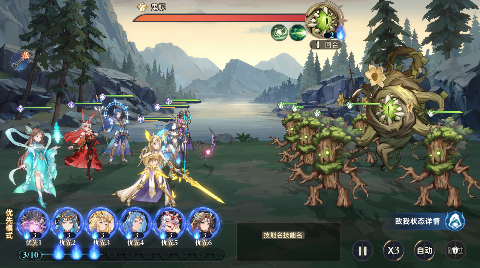
To start with the conclusion, what concerns me most about this game is actually not the gimmick of 0.1% discounts, nor the 334 sets of dynamic effects, but the impact of its “dual-form card” design on the competitive environment. Anyone who has played KPL knows that version changes are always the biggest variable affecting the direction of a match. In this game, every time an update adjusts the values of a soul master's dual forms or their cooldowns, it's like redrawing a line during the BP phase, directly affecting whether a certain team composition can appear in the match.
Previously, when I played mainstream card games, I was mostly concerned about the issue of numerical inflation. But in this game, because cards can switch forms, the ban and counter logic is more complex than in traditional card games. For example, the character Tang San: if you only look at the strength of his control form, he might be T0 before a version update. But if the update tweaks the angle or frame timing of his ultimate, his matchup against Xiao Wu's high-dodge rush system might develop a gap. This kind of strategic thinking is the same as in the LPL when checking if a player has a deep hero pool—players who only specialize in one form could be pushed back to square one if the version update doesn't favor them. Has anyone drawn up a table comparing the changes in soul-power skill cycles after form switching over the three versions so far?
The visual effects are really stunning, but I don't want to make this the main point. What I'm more interested in is the relationship between the game's social mechanics and a single card deck dominating everything, and I hope the developers pay more attention to this in future versions. After all, the core of competitive games is still balance, and balance isn't judged by how many gift packs you sell, but by whether you can retain players who are genuinely thinking about the mechanics and studying matchups when the version changes. 😈