
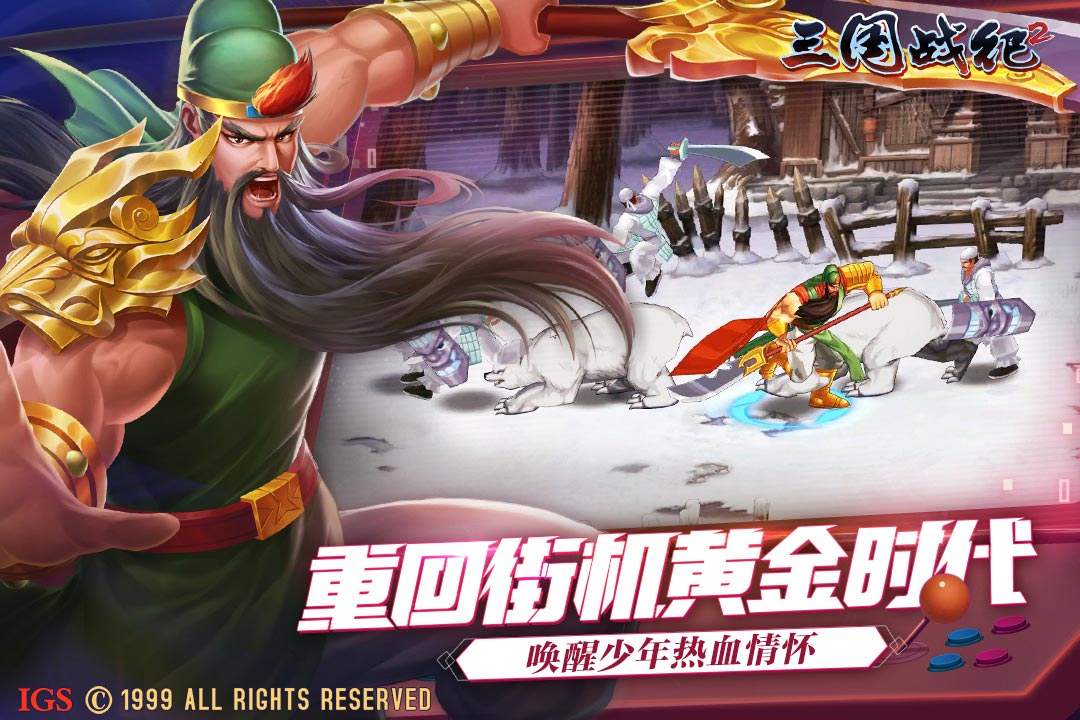
 Recently, while lurking in the Qitan Dimension, I've seen quite a few discussions about *Three Kingdoms: The Battle 2*. As someone who constantly follows KPL and LPL, I wasn't really into mobile games adapted from arcade IPs. But when my good brother pulled me into a team to complete some levels, saying it was for nostalgia, I ended up getting interested in its competitive environment. To sum it up, the competitiveness of this game, compared to similar side-scrolling action mobile games, is actually quite sincere. Its biggest advantage is that it doesn't simply rely on numeric stats to define battle power. Instead, it retains many aspects that require skill and game understanding to compensate for. Breaking it down, the game's competitive environment can roughly be divided into two parts. One is real-time sparring under fair conditions. This mechanism is similar to LOL's ARAM mode, where everyone starts equally, and it's purely about your understanding of the heroes and your control over skill frames, including startup and recovery times. For example, knowing when Guan Yu's Green Dragon Crescent Blade should be charged to counter Zhao Yun's Sky Soaring Dragon, or when Zhuge Liang should cast the Eight Trigrams Formation to perfectly interrupt Zhang Fei's Golden Bell Cover—these points of contention really test your brain and reaction skills early on, making fights very engaging. The other part includes army battles and large-scale battlefields with development elements. Honestly, these modes are often where high-spending players can dominate entire matches. But I was pleasantly surprised that Mokke (the developer) designed some limits in the progression system. You can clearly feel that team positioning and hero composition are more important than the stats of a single hero. For example, a team with a maxed-out pure damage lineup will be completely shut down if hit in the back row by an opponent's support setup with control items. This has a bit of the KPL team fight aesthetics—it's not about how much one player is ahead in economy, but about whether you and your teammates can trigger chain control combos together. Regarding the current metagame, I've observed a small hotspot where the classic item "Zhang Ling Sword" is slightly overperforming in some matches. This item quickly breaks resilience and is subtle at the start, allowing burst heroes to potentially one-shot enemies. But according to player feedback, experienced teams usually carry the "Tianshi Talisman" to counter control effects and turn the fight around.The restraint chain between these props actually ensures that the competitive environment won't fall into a "one-trick pony" dead end. There are indeed T0-tier characters in the current version. For example, Zhao Yun is still top-notch in terms of mobility and flexibility, but characters like Cao Pi and Lü Bu, who rely on super armor, are also starting to appear in later stages to counter Zhao Yun's displacement recovery. So if I were to rate the current balance of Sangokushi Battle 2, I'd give it a 7 out of 10. It's not perfectly balanced, but compared to many MMORPGs that purely sell stats, at least it gives ordinary players a path to climb through skill and awareness. The fun of teaming up lies in using the team to cover personal weaknesses, whereas one-on-one real-time duels are where your actual rank is truly tested. Additionally, I want to point out an area that could be optimized. The real-time duel matchmaking can sometimes feel too random. Facing several opponents well above my rank consecutively, losing isn't shameful, but you can definitely feel the gap in operational details and prop combo timing. If the developers could add some low-rank protection mechanisms in future updates, or create a standard mode that only uses basic props, allowing new players a longer buffer period to adapt, the competitive ecosystem of this game could be healthier. Overall, as a longtime observer, I'm really happy to see a mobile game with arcade genes that doesn't just rely on nostalgia but genuinely brings the strategic roulette of fighting games to the phone screen. If you're looking for a game to play with friends while also having the opportunity to practice skills individually, Sangokushi Battle 2 is really worth diving into. I'm looking forward to future updates adding a few new character faces and fine-tuning prop balance even more.
 The competitive balance of The King of Fighters 2001 is more interesting than I imagined.
Recently, while lurking in the Qitan Dimension, I've seen quite a few discussions about *Three Kingdoms: The Battle 2*. As someone who constantly follows KPL and LPL, I wasn't really into mobile games adapted from arcade IPs. But when my good brother pulled me into a team to complete some levels, saying it was for nostalgia, I ended up getting interested in its competitive environment. To sum it up, the competitiveness of this game, compared to similar side-scrolling action mobile games, is actually quite sincere. Its biggest advantage is that it doesn't simply rely on numeric stats to define battle power. Instead, it retains many aspects that require skill and game understanding to compensate for. Breaking it down, the game's competitive environment can roughly be divided into two parts. One is real-time sparring under fair conditions. This mechanism is similar to LOL's ARAM mode, where everyone starts equally, and it's purely about your understanding of the heroes and your control over skill frames, including startup and recovery times. For example, knowing when Guan Yu's Green Dragon Crescent Blade should be charged to counter Zhao Yun's Sky Soaring Dragon, or when Zhuge Liang should cast the Eight Trigrams Formation to perfectly interrupt Zhang Fei's Golden Bell Cover—these points of contention really test your brain and reaction skills early on, making fights very engaging. The other part includes army battles and large-scale battlefields with development elements. Honestly, these modes are often where high-spending players can dominate entire matches. But I was pleasantly surprised that Mokke (the developer) designed some limits in the progression system. You can clearly feel that team positioning and hero composition are more important than the stats of a single hero. For example, a team with a maxed-out pure damage lineup will be completely shut down if hit in the back row by an opponent's support setup with control items. This has a bit of the KPL team fight aesthetics—it's not about how much one player is ahead in economy, but about whether you and your teammates can trigger chain control combos together. Regarding the current metagame, I've observed a small hotspot where the classic item "Zhang Ling Sword" is slightly overperforming in some matches. This item quickly breaks resilience and is subtle at the start, allowing burst heroes to potentially one-shot enemies. But according to player feedback, experienced teams usually carry the "Tianshi Talisman" to counter control effects and turn the fight around.The restraint chain between these props actually ensures that the competitive environment won't fall into a "one-trick pony" dead end. There are indeed T0-tier characters in the current version. For example, Zhao Yun is still top-notch in terms of mobility and flexibility, but characters like Cao Pi and Lü Bu, who rely on super armor, are also starting to appear in later stages to counter Zhao Yun's displacement recovery. So if I were to rate the current balance of Sangokushi Battle 2, I'd give it a 7 out of 10. It's not perfectly balanced, but compared to many MMORPGs that purely sell stats, at least it gives ordinary players a path to climb through skill and awareness. The fun of teaming up lies in using the team to cover personal weaknesses, whereas one-on-one real-time duels are where your actual rank is truly tested. Additionally, I want to point out an area that could be optimized. The real-time duel matchmaking can sometimes feel too random. Facing several opponents well above my rank consecutively, losing isn't shameful, but you can definitely feel the gap in operational details and prop combo timing. If the developers could add some low-rank protection mechanisms in future updates, or create a standard mode that only uses basic props, allowing new players a longer buffer period to adapt, the competitive ecosystem of this game could be healthier. Overall, as a longtime observer, I'm really happy to see a mobile game with arcade genes that doesn't just rely on nostalgia but genuinely brings the strategic roulette of fighting games to the phone screen. If you're looking for a game to play with friends while also having the opportunity to practice skills individually, Sangokushi Battle 2 is really worth diving into. I'm looking forward to future updates adding a few new character faces and fine-tuning prop balance even more. Replies (0)
— All replies loaded —